Most people buy a red light mask for their face, use it on their face, and never think about the ten centimetres below the jawline — which is usually the first place that shows age and the last place anyone applies sunscreen.
This guide covers the full face-and-neck routine: how to actually run a session, where the neck fits in, how often to do it, and what separates a mask worth owning from one that just glows.
Before You Start: The One Rule That Matters Most
Clean, dry, bare skin. No makeup, no sunscreen, no serum, no moisturiser, no oil.
This isn't a nice-to-have. Anything sitting on your skin sits between the LEDs and you. Sunscreen in particular is engineered to block light — using a mask over sunscreen largely defeats the point of the session.
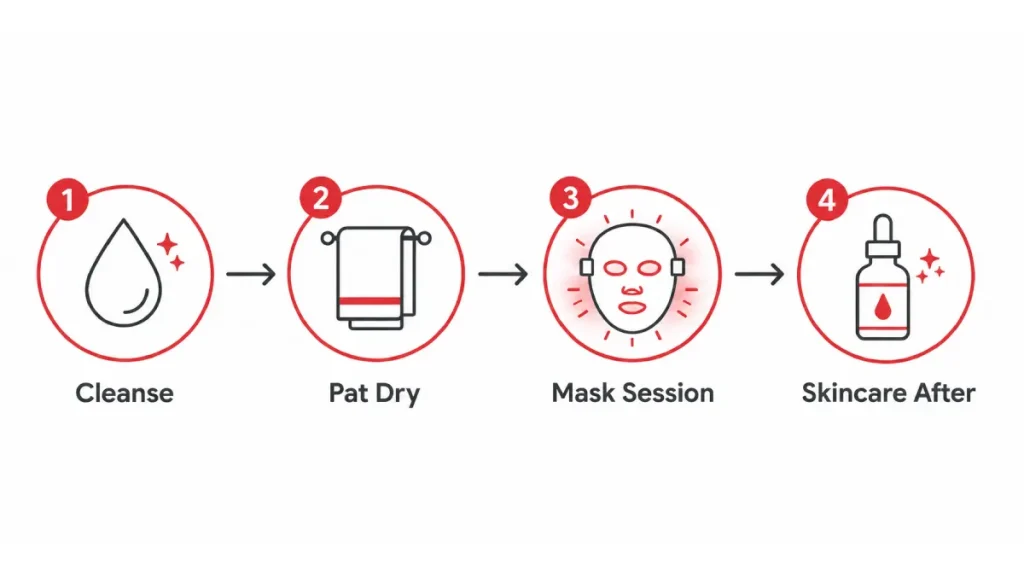
The order is always: cleanse → pat dry → mask session → then skincare. Products go on afterwards, never before.
The Face and Neck Routine, Step by Step
1. Cleanse and pat dry. Remove everything. Damp skin is fine to work with once patted down; wet skin isn't.
2. Position the mask properly. Contact and coverage matter more than people expect. A mask sitting at an angle leaves gaps — usually around the jawline, temples, and the sides of the nose. Adjust the straps so it sits flush rather than just resting on your face.
3. Run the session for the recommended time. Session lengths vary widely across devices — some run 3 minutes, others 10 to 20. This depends on the mask's output, not on which brand is "better." Follow your specific device's guidance rather than a number you read online.
4. Don't extend the session. This is worth stating plainly because it's the most common mistake: longer is not better. Photobiomodulation follows what researchers call a biphasic dose response — the effect increases up to an optimal dose, then diminishes past it. Doubling your session time doesn't double anything. Our photobiomodulation guide covers why this happens.
5. Do the neck and décolletage. If your mask covers the neck, extend the session down. If it doesn't, this is where a separate neck attachment or a repositioned session comes in. The skin here is thinner than facial skin, gets significant sun exposure, and is routinely skipped in skincare routines — which is exactly why it tends to age visibly earlier.
6. Apply skincare afterwards. Serums and moisturiser go on once the session is done.
7. Wipe the mask down. The inner surface picks up skin oils and dust. A quick wipe with a soft cloth after each use keeps it clean and stops buildup on the LED surface.
How Often?
Most at-home mask routines run 3 to 5 sessions per week, though some devices are designed for daily use. Check your device.
More important than frequency: consistency over weeks. Skin-related routines are generally assessed over 8 to 12 weeks, not days. Judging results after a fortnight is too early — and results vary significantly between individuals regardless of how consistent you are.
Morning or Evening?
Either works. There's no established evidence favouring one over the other for red light specifically.
Practical considerations tend to decide it:
- Evening suits most people better, because you're not applying makeup or sunscreen straight after and the session doubles as a wind-down.
- Morning works if that's when you'll actually be consistent — and consistency beats optimal timing every time.
What to Look For in a Mask
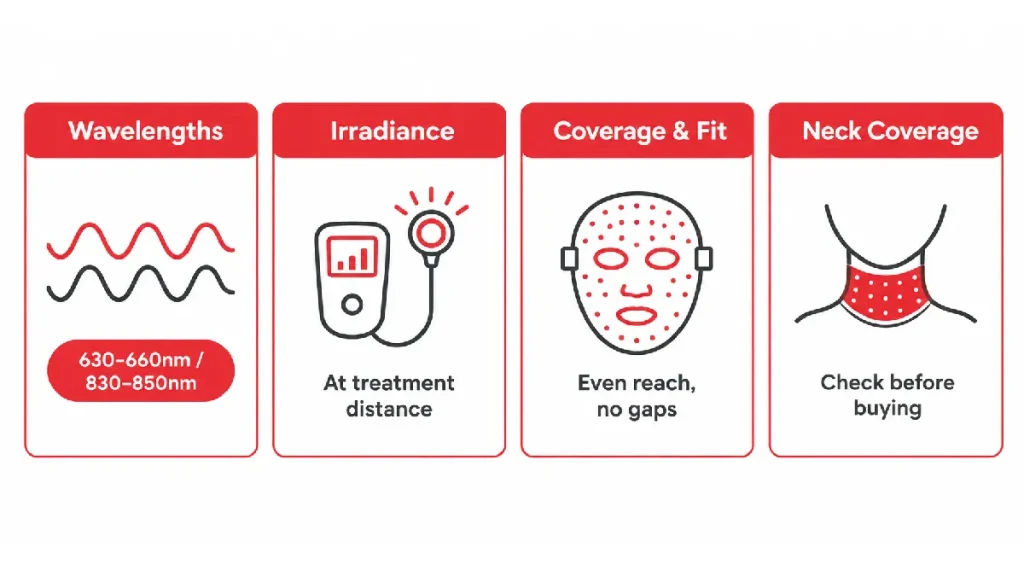
If you're still choosing one, four things genuinely matter and the rest is mostly marketing:
Wavelengths. Red light around 630–660nm and near-infrared around 830–850nm are the ranges with the most established research behind them. A mask should state its wavelengths clearly. Multi-colour masks add blue, green, and yellow — these interact more with the skin's surface and serve different purposes; they're not an upgrade to red and near-infrared, just an addition.
Irradiance, stated at a real distance. This is the output actually reaching your skin, measured in mW/cm². Watch for a common trap: some manufacturers quote irradiance measured at the LED surface rather than at treatment distance, which produces a much bigger number that doesn't reflect what your skin receives. A mask sits directly on the face so distance is less of a variable than with panels, but the specification should still be disclosed.
Coverage and fit. LED count on its own means very little — 200 LEDs at low output is not better than 100 at appropriate output. What matters is whether the light reaches the areas you care about, evenly. A rigid mask that gaps at the jawline delivers less to the jawline, regardless of the spec sheet.
Whether it covers the neck. Many masks stop at the jawline. If the neck and décolletage are part of why you're buying, check this before you order rather than after.
Our LED face mask buyer's guide goes deeper on comparing devices, and the 660nm and 850nm buyer's guide covers the wavelength side specifically.

Eye Protection
Red light masks don't emit UV, but they are bright at close range. Many include eye shields or have cut-outs; some are designed to be used with eyes closed. Follow your device's guidance, and don't stare directly into the LEDs regardless of what it says.
If safety is a broader concern for you, we've covered the most common question about it directly in does red light therapy cause cancer?
Realistic Expectations
Worth being straight about this: what the research supports for skin is gradual, modest change in texture and the appearance of fine lines over consistent use — not dramatic transformation, and not on a fixed timeline. Some people notice a difference; some don't. Results vary.
If you want the fuller picture of what's genuinely well-supported, our red light therapy for wrinkles and does red light therapy tighten skin articles cover the research honestly, including its limits.
FAQs
Can I use a red light mask on my neck? Yes — either with a mask that extends below the jawline, a dedicated neck attachment, or by repositioning. The neck and décolletage are commonly skipped and often show ageing earlier than the face.
Should I use skincare before or after a mask session? After. Anything applied beforehand sits between the LEDs and your skin and reduces how much light gets through.
How often should I use an LED face mask? Most routines run 3 to 5 times per week, though some devices are designed for daily use. Check your device's guidance — and prioritise consistency over intensity.
Is a longer session better? No. Photobiomodulation has a biphasic dose response, meaning benefit peaks at an optimal dose and diminishes beyond it. Extending sessions past the recommended time doesn't scale up results.
Do I need eye protection with an LED mask? Masks don't emit UV, but they're bright at close range. Follow your device's guidance — many include shields or are designed to be used with eyes closed.
How long until I see a difference? Skin routines are generally assessed over 8 to 12 weeks of consistent use. Results vary significantly between individuals and aren't guaranteed.
This device is a general wellness product and is not intended to diagnose, treat, cure, or prevent any disease. Individual results vary. If you are pregnant, photosensitive, taking light-sensitising medication, or have a diagnosed health condition, check with a health professional before use.