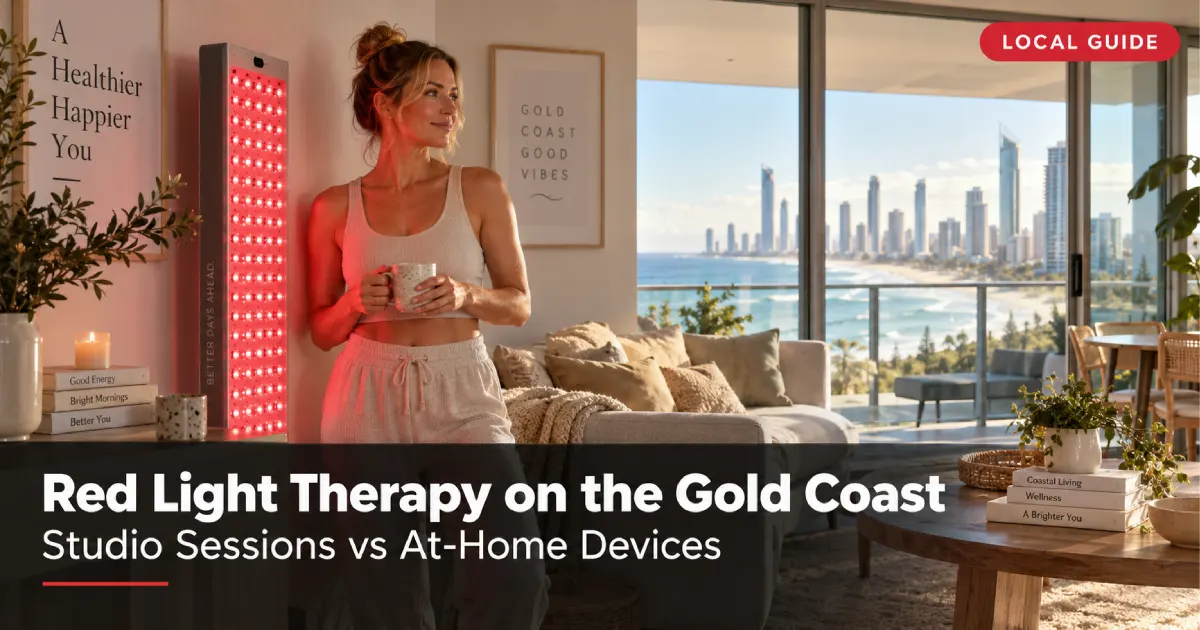
If you've searched "red light therapy Gold Coast," you're probably weighing up two very different things: booking sessions at a local studio, or buying a device and running your own routine at home.
Both work as a routine. They suit different people, different budgets and — realistically — different levels of follow-through. Here's an honest comparison, from a local supplier who sells the at-home option.
What's available on the Gold Coast
Red light therapy has spread across the Gold Coast the same way it has across the rest of Australia — mostly through wellness studios, tanning and beauty salons, recovery gyms and physio clinics rather than standalone red light venues. You'll usually find it as an add-on service: a full-body bed or upright unit, or a panel used on a specific area.
Most places sell it per session, or as a discounted multi-session pack. Session lengths are typically in the 10–20 minute range, and studios generally recommend coming in a few times a week rather than occasionally.
Prices vary a lot between venues and change often, so it's worth ringing two or three places near you — Southport, Burleigh, Robina and Coomera all have options — rather than relying on a number you read online.
The real trade-off: coverage vs consistency
This is the decision most people get wrong, so it's worth being blunt about it.
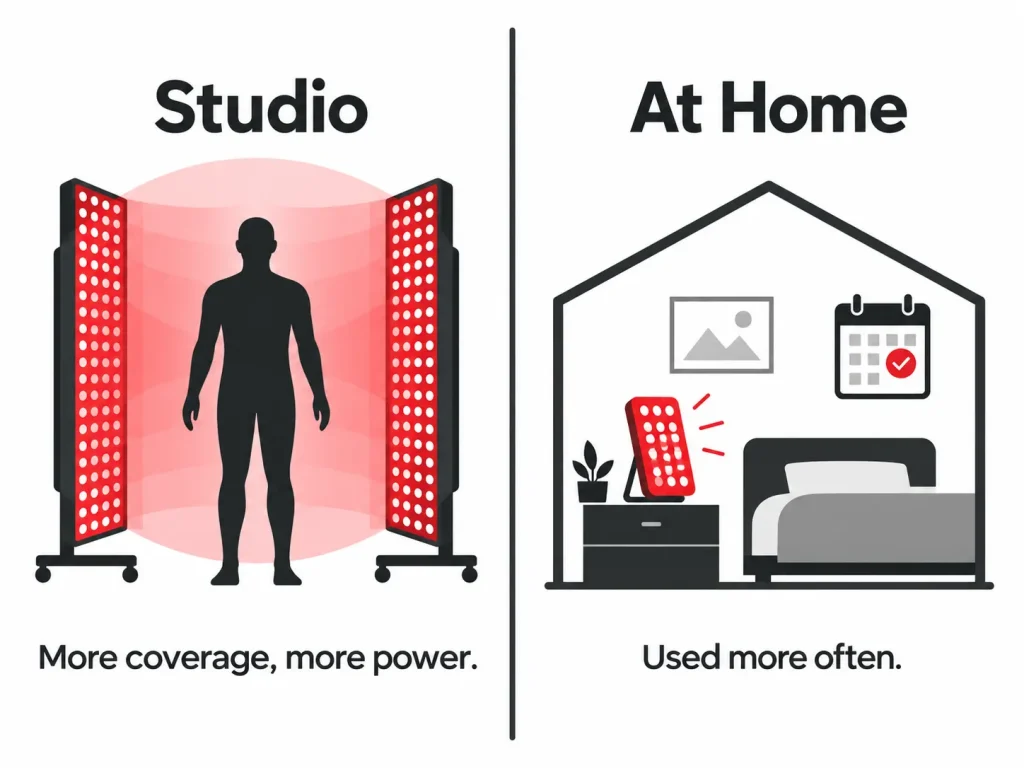
Studios win on coverage and power. A commercial full-body bed puts light across your whole body at once, at an output no at-home device matches. If whole-body coverage is what you're after, that's a genuine advantage.
At-home devices win on consistency. Red light therapy is a routine, not a one-off. Whatever you choose has to survive rainy Tuesdays, traffic on the M1, and the week your schedule falls apart. A device sitting in your bedroom gets used on those days. A booking 25 minutes away often doesn't.
Nobody can tell you which of those two matters more for you. But be honest with yourself about the second one before you spend money on either.
Cost, over a year
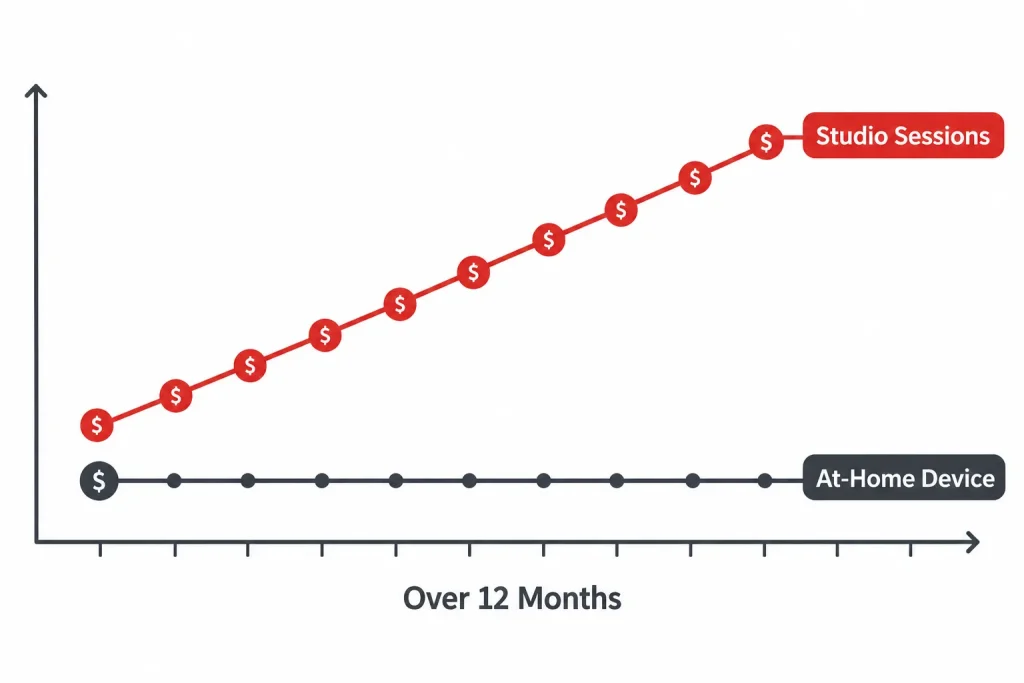
Studio sessions are cheap to start and expensive to continue — you're paying every single time, forever. At-home devices are the reverse: a real upfront cost, then effectively nothing.
The crossover point depends entirely on how often you actually go. Work out roughly how many studio sessions you'd realistically do in twelve months, multiply by the local per-session price, and compare that to the one-off cost of a device. For most people who intend to use it several times a week, the device comes out ahead within the first year. For someone who wants it occasionally, it doesn't.
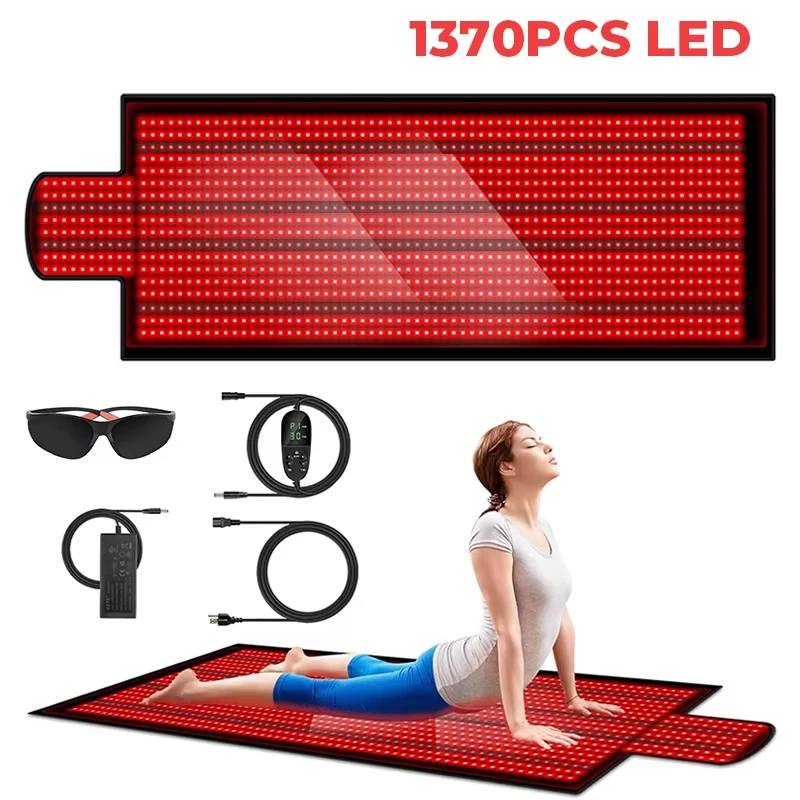
Alpha's at-home range sits between a targeted red light therapy belt for focused coverage and a full-body mat for larger-area sessions. You can see the full range on our shop page.
What to ask a Gold Coast studio before booking
- What wavelengths does the unit use? Most of the research attention sits on red light around 630–660nm and near-infrared around 810–850nm. A studio that can answer this in nanometres has done its homework.
- How long is a session, and how many do you recommend?
- Is there an intake or health form? Reputable venues will ask.
- What's the cancellation and pack expiry policy? Multi-session packs that expire in eight weeks are a different deal to ones that don't.
- Can I see the unit before I book? Panel size and whether you're lying down or standing changes the experience considerably.
What to check before buying an at-home device
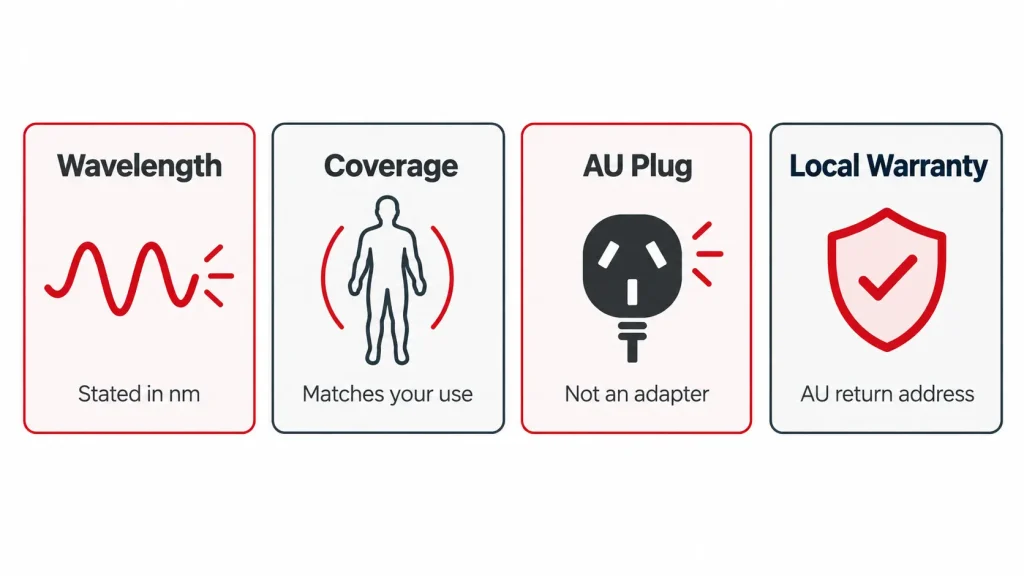
- Wavelengths listed clearly in nanometres, not just "red light."
- Coverage area that matches what you actually want to use it on.
- A proper Australian plug, not an overseas unit with an adapter in the box.
- Local warranty and a local return address — this is the one people skip and regret.
- Honest claims. If a listing promises to fix a specific medical condition, treat that as a warning sign rather than a selling point.
On that last point, "TGA approved" gets used loosely in this market. Most at-home red light devices in Australia — including ours — are sold as general wellness and cosmetic products, not as registered medical devices. We've written up how ARTG listing actually works here: medical grade red light therapy devices Australia.
Can you do both?
Plenty of people do, and it's a sensible middle path: a device at home for the regular routine, plus occasional studio sessions when they want whole-body coverage. The two aren't mutually exclusive, and starting with a studio for a few weeks is a reasonable way to find out whether the routine suits you before buying anything.
New to this entirely?
If you're still working out what red light therapy actually is before deciding where to do it, start here: what is red light therapy? And once you've got a device, our guide to using red light therapy at home covers setting up a routine that you'll stick to.
About Alpha
Alpha Red Light Therapy supplies at-home red and near-infrared LED devices to customers across Australia, with local shipping and local support. We sell general wellness and cosmetic devices — we don't run a clinic, and we don't make medical claims about our products. If you'd rather try a studio session first, that's a perfectly reasonable place to start.
FAQ
Where can I do red light therapy on the Gold Coast? It's most commonly offered as an add-on at wellness studios, beauty and tanning salons, recovery gyms and some physio clinics across the Gold Coast. Availability and pricing change often, so it's worth calling a few places near you.
Is it cheaper to buy a device or book studio sessions? It depends on how often you'll use it. Studio sessions cost less upfront but keep costing; a device is a one-off. For people planning to use it several times a week, a device usually works out cheaper within the first year.
How long is a red light therapy session? Most studio and at-home sessions run in the 10–20 minute range. Follow the studio's guidance or your device's manual rather than a generic number.
Do you have a Gold Coast showroom? Alpha is an online supplier shipping across Australia. We don't operate a walk-in clinic or studio.
Are at-home devices as powerful as studio units? Commercial full-body units generally deliver more coverage and output in a single session. At-home devices trade some of that for convenience, which is what makes a regular routine realistic for most people.
Disclaimer
Alpha Red Light Therapy devices are general wellness and cosmetic products. They are not intended to diagnose, treat, cure or prevent any disease. Information on this page is general in nature and is not medical advice. Individual results vary. If you have a diagnosed condition, are pregnant, or take photosensitising medication, speak with a qualified health professional before starting any light-based routine.