Last updated: July 2026 · Reading time: ~9 minutes
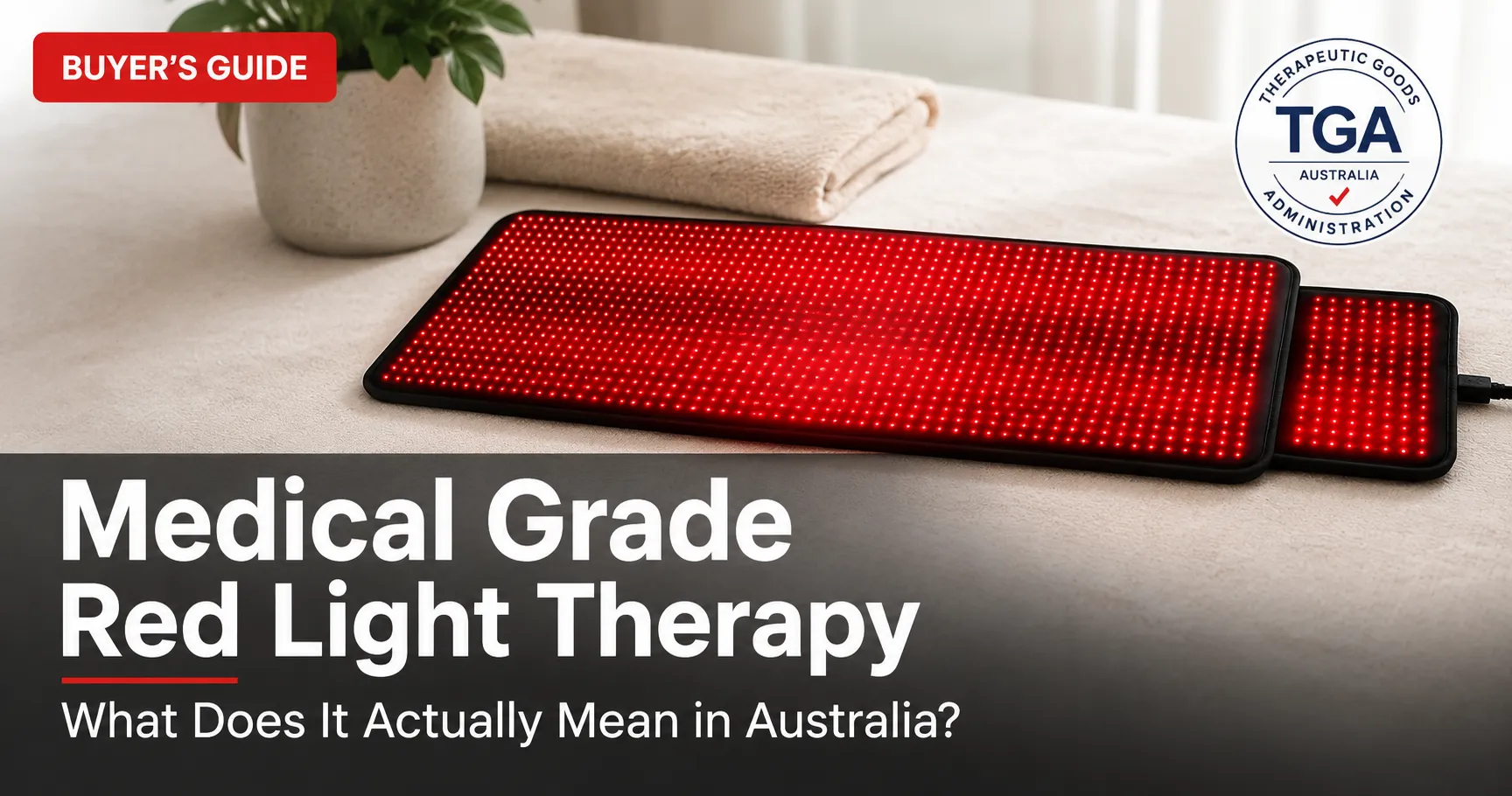
Quick answer: In Australia, "medical grade" isn't a feeling — it maps to a real regulatory status. A device only needs listing on the Australian Register of Therapeutic Goods (ARTG) if the seller makes specific therapeutic claims about it. Most home red light products — belts, mats, blankets — are sold as general wellness devices instead. Neither category is automatically better; what matters is whether the label matches what's genuinely registered.
If you've compared red light therapy devices for sale in Australia, you've seen "medical grade" attached to almost everything — sitting right next to the price, doing a lot of persuasive work.
The problem is that almost nobody defines it the same way twice. Some sellers mean "TGA-listed." Others mean "higher wattage than the cheap ones." A few just mean "trust us." This buyer's guide breaks down what the term is actually supposed to mean, how to check a specific claim yourself in about two minutes, and why a device that isn't marketed as medical grade isn't automatically the weaker choice for a home routine.
What "Medical Grade" Is Supposed to Mean
Therapeutic goods in Australia — including red and near-infrared light devices — sit under the Therapeutic Goods Administration (TGA). Whether a specific device needs to be on the Australian Register of Therapeutic Goods (ARTG) comes down to one thing: the claims made about it, not the LEDs inside it.
If a company markets a light device as diagnosing, treating, or managing a specific medical condition, that product generally meets the legal definition of a medical device and is expected to sit on the ARTG, risk-classified from Class I up through Class III (with IIa and IIb tiers in between).
If a company sells comparable hardware but positions it as a general wellness product — built around an at-home comfort routine, without naming the specific conditions it treats — it can typically sit outside that registration requirement entirely.
This is the part most product pages skip: "medical grade" isn't a description of build quality. It's a regulatory status tied to the specific claims a seller is legally making. Two devices can run identical 660nm and 850nm LEDs, and only one of them is technically "medical grade" — because only one of them is registered for claims that require it.
Why the Term Gets Used So Loosely
Search for red light devices sold to Australians and you'll find "medical grade" attached to home wearables, face masks, and full-body panels with no visible TGA or ARTG reference anywhere on the page. That's not always dishonest — used loosely, without specific condition-related claims attached, the phrase can just mean "built with higher-spec components than a toy." But it's also exactly the phrasing that makes a product sound more credible than a general wellness device, which is precisely why it shows up everywhere.
The honest version of this section is short: the word alone tells you nothing. The only way to know what a specific seller actually means by it is to check.
Three Things Buyers Regularly Get Wrong
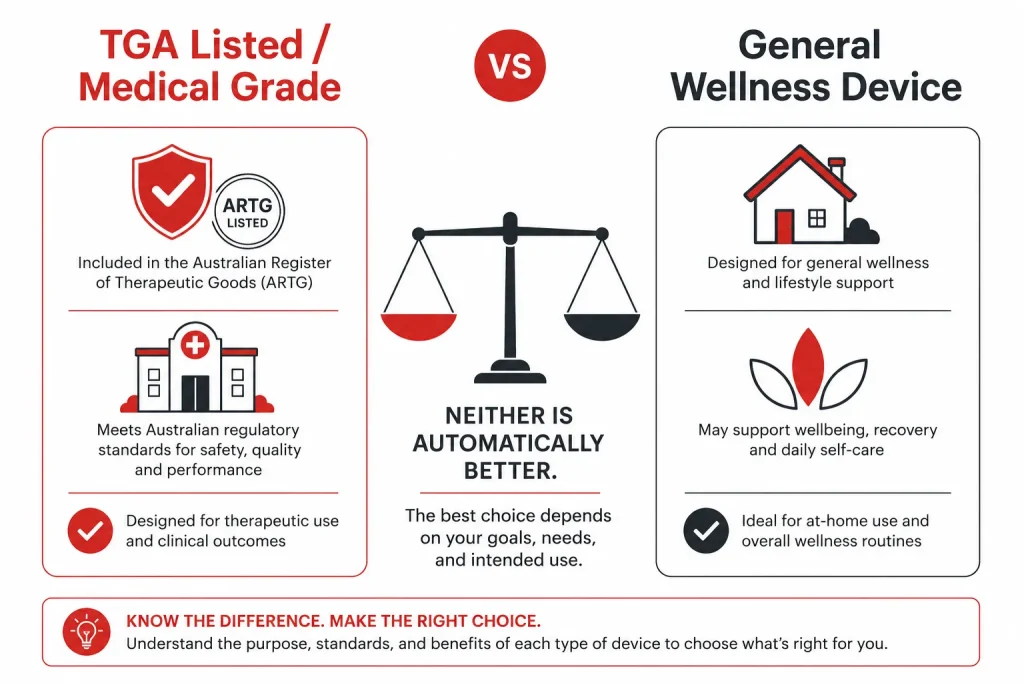
"No TGA listing means the device is inferior or fake." Not necessarily. It usually just means the product is being sold as a general wellness device rather than a registered therapeutic good. That's a different category, not a lower one — most belts, mats, and blankets on the Australian market fall here, deliberately.
"A high wattage number on the box proves it's medical grade." Input wattage — how much power a device draws from the wall — isn't the same as irradiance, which is how much usable light actually reaches your skin at a working distance. A device can print an impressive wattage figure on the packaging and still deliver an unremarkable real-world dose. If a seller won't share irradiance data, that's more telling than the wattage number ever will be.
"FDA-cleared means the same thing as TGA medical grade here." FDA clearance is a US regulatory pathway. It doesn't automatically transfer to, or equal, Australian TGA/ARTG registration. A device can be FDA-cleared in the US market and simply not appear on the ARTG in Australia at all — the two systems are separate.
How to Actually Check (Takes About Two Minutes)
The ARTG is a public database. No account or special access required.
- Search "ARTG search" or go directly to the TGA's search tool (the newer visualisation tool is at compliance.health.gov.au/artg).
- Search by the product name or the selling company's name.
- A genuine listing shows a public summary: ARTG ID, sponsor (company) name, product classification, and the date it was listed.
- Nothing comes up? The product isn't currently registered — which usually just means it's marketed as a general wellness device, though it's fair to ask the seller directly if their page is making specific therapeutic claims without one.
This one check cuts through more marketing language than any spec sheet.
Medical-Grade vs General Wellness: Side by Side
| TGA-Listed "Medical Grade" | General Wellness Device | |
|---|---|---|
| Regulatory status | Included on the ARTG, risk-classified | Not required to be on the ARTG |
| Typical setting | Clinics, physio and dermatology practices | At-home routines |
| Claims permitted | Specific therapeutic claims, within registration | Wellness and comfort-routine framing only |
| Usual price range | Higher — reflects compliance, testing, clinic-grade builds | Lower to mid-range — built for everyday home use |
| Best suited to | Practitioner-supervised use, clinical settings | Personal, ongoing at-home comfort routines |
Neither column is "the good one." A general wellness device that's honest about being a general wellness device is a completely reasonable choice for a home routine — it's the entire category the belt, mat, and blanket market is built on.
Do You Actually Need a Medical-Grade Device at Home?
For most people building a personal at-home routine — a few focused-coverage sessions a week with a belt, or larger-area sessions with a mat before bed — the honest answer is no. TGA listing matters most when:
- You're following a specific plan set by a health professional, and want the device used in that plan to be the exact one it was tested and registered for.
- You're setting up a clinic and need to make specific therapeutic claims to clients.
- You simply want the reassurance of an independently verifiable regulatory listing, and are comfortable with the price difference that usually comes with it.
Outside of those situations, what should actually drive the decision is the same as any other electronics purchase: published specs you can verify, realistic marketing, and a company that answers questions plainly.
What to Check Instead of Chasing a Label
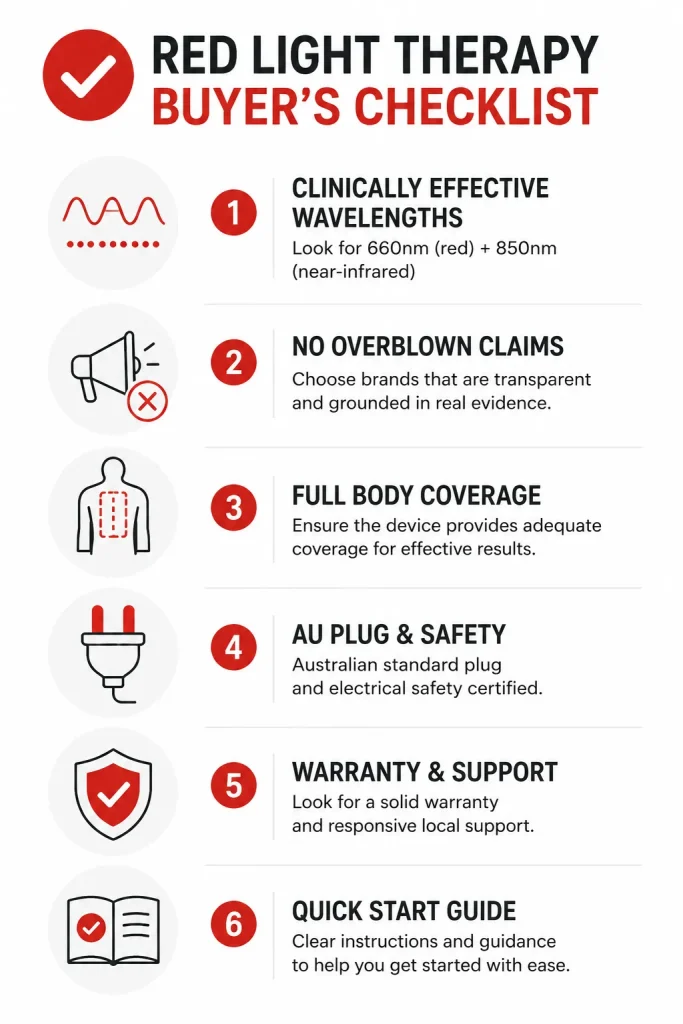
Whether or not a device carries a "medical grade" sticker, these are the things worth your time:
- Stated wavelengths. Look for specific numbers — 660nm red and 850nm near-infrared is the standard pairing across the category (we've broken this down in more depth in our 660nm and 850nm buyer's guide). Vague phrases like "clinically proven wavelengths" with no numbers attached are a soft red flag.
- Realistic marketing. A seller that sticks to wellness and comfort-routine language, and is upfront that results vary, is generally more trustworthy than one making sweeping condition-specific promises with no ARTG listing behind them.
- Coverage that matches the format. A focused-coverage device like a belt is built for one area at a time; a mat or blanket is built for larger-area sessions. Neither needs a "medical grade" label to do its job — it needs to match how you'll actually use it.
- Local plug type and support. A device built for the Australian market with AU plugs and local support saves you the adapter-and-time-zone problem that comes with a lot of overseas listings.
- A published warranty and returns policy you can read before buying — not a vague "quality guaranteed" badge.
- A proper quick-start guide included. A company that walks you through product setup — session length, distance, frequency — instead of leaving you to guess, is investing in you actually using what you bought.
Where Alpha Fits In
We'll be straight with you: the Alpha Red Light Therapy Belt and Alpha Red Light Therapy Mat are not marketed as TGA-listed medical-grade devices. They're general wellness devices, built for at-home comfort and recovery routines — focused coverage from the belt, larger-area sessions from the mat — using the 660nm red and 850nm near-infrared pairing that's become the category standard.
We'd rather say that plainly than borrow a label that doesn't apply to us. What's actually in our control is stated clearly: the wavelengths we use, AU plugs with local Gold Coast support, a published warranty and returns policy, and a real quick-start guide before you switch the device on. You can read more about the wavelengths themselves on our how it works page.
If your situation specifically calls for a TGA-listed device — say, you're working with a health professional on a defined plan — that's a conversation for your practitioner and a clinic-supplied device, not a general home wellness product like ours.
Frequently Asked Questions
What does "medical grade" mean for a red light therapy device in Australia?
It generally refers to a device listed on the Australian Register of Therapeutic Goods (ARTG) because the seller is making specific therapeutic claims about it, risk-classified under TGA rules. Used outside that context, it's often just a marketing phrase with no formal registration behind it.
How can I check if a red light therapy device is actually TGA-listed?
Search the product or seller's name on the TGA's ARTG search tool (available via compliance.health.gov.au/artg or the TGA website). A genuine listing shows a public summary with an ARTG ID, sponsor name, and listing date. No result means it isn't currently registered.
Do I need a medical-grade device for a home routine?
Not usually. Most people using a belt, mat, or blanket as part of a personal at-home comfort routine are well served by an honestly-marketed general wellness device. TGA listing matters most in clinic settings or when following a specific plan with a health professional.
Can any brand call its product "medical grade"?
This is really a legal question rather than a marketing one, and the TGA's own guidance on therapeutic claims is the authoritative source — a business making specific condition-related claims would generally be expected to have genuine ARTG registration behind them.
What's the real difference between a clinic device and a home device?
Clinic devices are typically used under practitioner supervision, often carry ARTG registration tied to specific therapeutic claims, and are priced accordingly. Home devices are built for personal, ongoing at-home routines, are usually more affordable, and are marketed with general wellness language rather than condition-specific claims.
Does Alpha sell medical-grade devices?
No — Alpha's belt and mat are marketed as general wellness devices for at-home comfort and recovery routines, not as TGA-listed medical-grade devices. We'd rather be upfront about that than use a label that doesn't apply.
The Bottom Line
"Medical grade" is a real regulatory status in Australia, not just a persuasive adjective — and the only way to know what a specific seller means by it is to check the ARTG yourself, which takes about two minutes. For most people building an at-home comfort and recovery routine, a well-specified, honestly-marketed general wellness device does exactly the job it's meant to do. Chase verifiable specs and straight talk from the seller, not the label on the box.
If you're still comparing models overall rather than checking one specific claim, our guide to the best red light therapy devices in Australia walks through that decision end to end.
This article is for general information only and isn't legal or regulatory advice. The products discussed are general wellness devices and are not intended to diagnose, treat, cure or prevent any disease or medical condition. If you are pregnant, photosensitive, using medication that increases light sensitivity, or under medical care, please check with a qualified health professional before use.