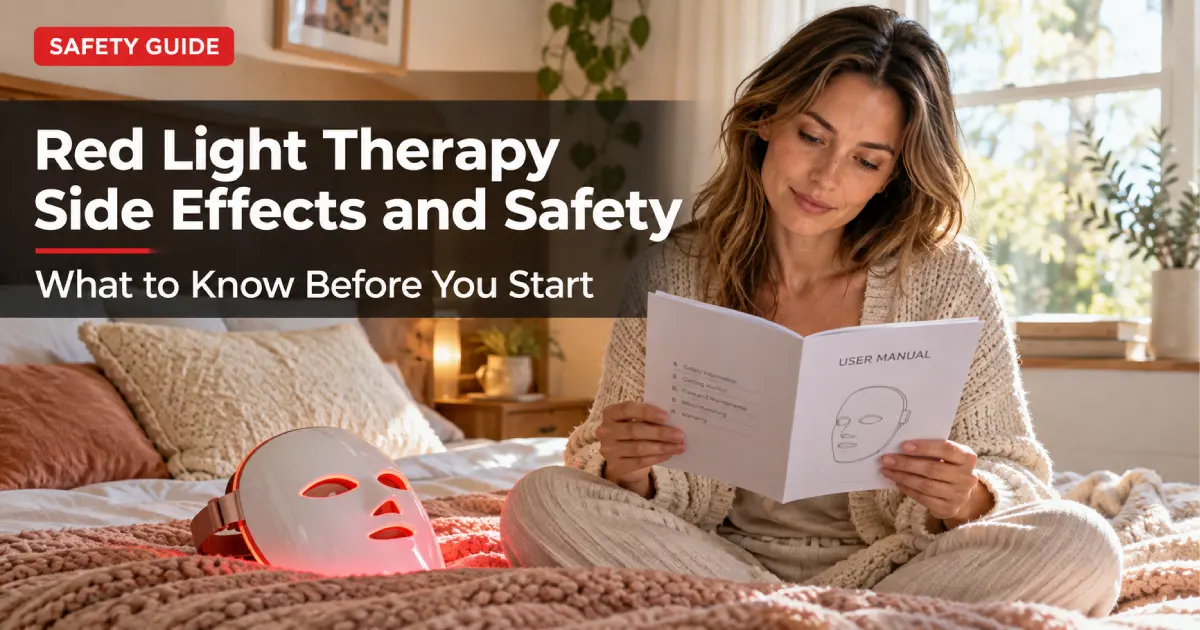
If you're about to spend a few hundred dollars on an at-home red light device, checking the safety question first is the sensible order to do things in.
Here's what the available evidence actually says, what it doesn't, and the specific situations where checking with a doctor first is the right call. We sell these devices, so read this knowing that — but we've kept it to what published sources support, and we've said where the evidence runs out.
The short version
For short-term use, following the manufacturer's instructions, red light therapy has a good safety record. The Cleveland Clinic describes it as appearing safe and not associated with side effects when used short-term and as directed, and notes it doesn't use the UV light associated with skin cancer risk.
Two important qualifications sit alongside that.
First, the long-term safety of these devices isn't established. Cleveland Clinic states that plainly. Most published research covers weeks or months of use, not years. Anyone telling you decades of daily use is proven safe is going beyond the evidence.
Second, "safe as directed" is doing real work in that sentence. Cleveland Clinic notes that misuse — using a device too often, or not according to its instructions — carries a chance of damaging skin or unprotected eyes. The safety record belongs to correct use, not to the technology in the abstract.
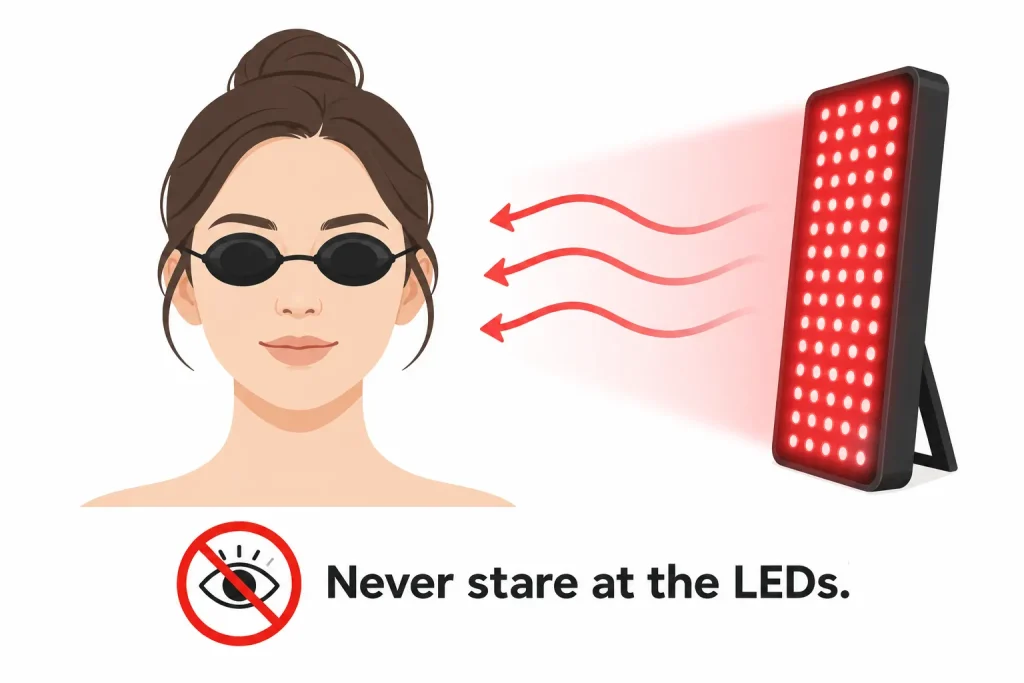
Eyes: the one that actually matters
This is the risk worth taking seriously, and it's the one most cheaply-marketed devices gloss over.
ARPANSA, Australia's radiation protection authority, notes that exposure to LED sources can present a hazard to the eye depending on the intensity and duration of exposure. Brown University Health puts it more directly still, advising protective goggles during red light therapy because the light can damage your eyes.
Practically:
- Use the eye protection supplied with your device. If a device ships without any and the manual doesn't address eyes, that tells you something about the manufacturer.
- Don't stare into the LEDs. Not at any distance, not "just to check it's working."
- Close your eyes during face and neck sessions even with a mask designed to sit over them.
- Keep children and pets out of the room during a session, since neither will follow that advice.
If you have any existing eye condition, this is a conversation to have with your optometrist or GP before you start, not after.
Possible side effects
The realistic list is short, and most of it comes from overuse rather than normal use.
Skin redness, warmth or irritation. Usually mild and temporary. Brown University Health notes that high levels of red light can cause redness, swelling and blistering — that's the overexposure end of the scale, not what a properly-timed session produces.
Eye strain or headache. Bright light for 10–20 minutes in a dim room does this to some people. Usually solved by proper eye protection and a less dim room.
Heat discomfort. Some devices include a heating element, and some people simply run warm during a session. If it's uncomfortable, stop.
Disrupted sleep after late sessions. Worth flagging for a specific reason. ARPANSA notes that exposure to blue light — a component of some LED phototherapy — suppresses melatonin, which helps regulate sleep and wake cycles, and that the research here is ongoing. This matters mainly for multi-colour "7-colour" LED masks with a blue setting, less so for red and near-infrared-only devices. If you're using a blue setting, earlier in the evening is the sensible choice.
The general rule: if anything feels uncomfortable, stop the session. Discomfort is not something to push through.
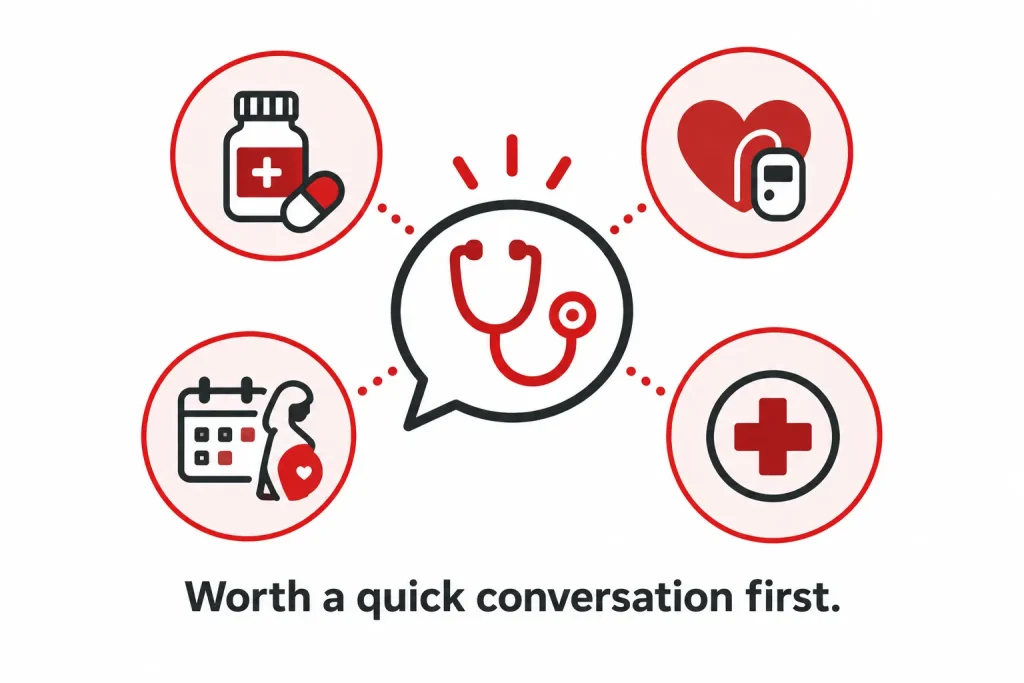
Who should check with a doctor first
None of the following means you can't use a device. It means the conversation is worth having before you start rather than after.
A history of skin or eye cancer. Brown University Health advises consulting your oncologist or GP before using red light therapy.
Medication that increases light sensitivity. Some medications raise photosensitivity. Your pharmacist can tell you in about thirty seconds whether anything you take falls into that group — ask them, rather than guessing from a list online.
Pregnancy. Not because there's established evidence of harm, but because there isn't much evidence either way, and that's reason enough to ask.
A diagnosed skin condition you're actively being treated for, or recent procedures on the area you're planning to use it on.
An implanted device such as a pacemaker — check your device's own manual, which will address this directly.
Epilepsy or light-sensitive conditions, particularly with devices that offer pulse or flashing modes.
If you're specifically worried about the cancer question, we've written that up separately with sources: does red light therapy cause cancer?
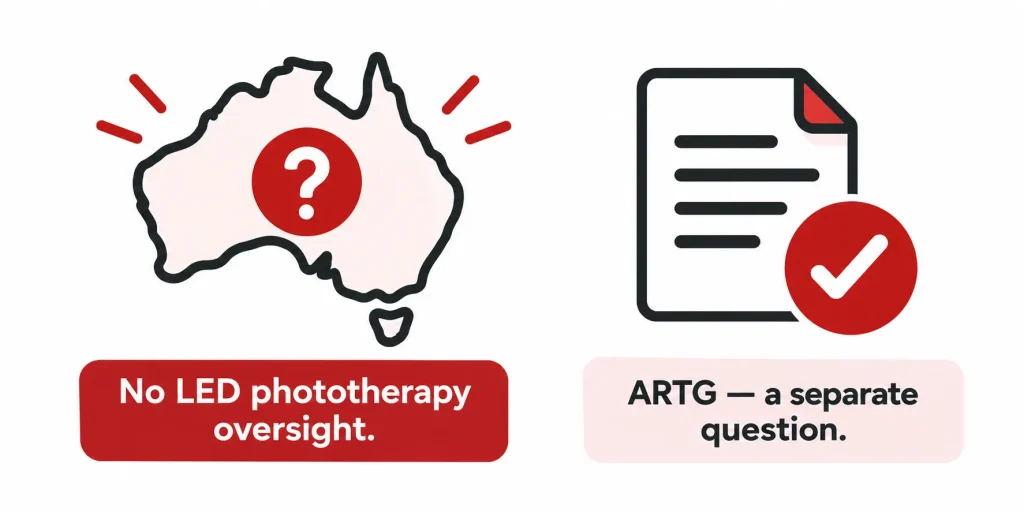
The Australian gap nobody mentions
Here's something worth knowing before you buy, and you won't find it on most product pages.
ARPANSA's position on LED phototherapy is direct: there is, in its words, "no oversight and very little information available" for providers or consumers. Lasers are regulated in Queensland, Tasmania and Western Australia. IPL is regulated in Tasmania. LED phototherapy is regulated in none of them.
That's separate from the TGA question, which concerns whether a device making therapeutic claims is included on the Australian Register of Therapeutic Goods — we've covered that here: is red light therapy TGA approved in Australia?
What the gap means in practice: nobody is checking the output claims on the device you're about to buy. A listing can state any irradiance or wavelength figure it likes with no regulator verifying it. That puts the responsibility on you to buy from a seller who publishes real specifications and a real manual.
To be direct about our own position: Alpha's devices are sold as general wellness and cosmetic products. They are not ARTG-registered medical devices, and we don't claim they are.
How to keep risk low
Nothing complicated:
- Read the manual before the first session. Every device has its own recommended distance, duration and frequency, and those numbers are not interchangeable between brands.
- Start shorter than the maximum. Ten minutes before twenty. See how your skin responds over the first week.
- Use the eye protection supplied.
- Don't stack devices — a mask and a mat in the same session is not the same as following either manual.
- More is not better. Longer sessions aren't a shortcut, and the overexposure end of the scale is where the side effects live. On frequency: how often should you use red light therapy
- Keep the device surface clean and dry, and don't apply oils or creams under it.
- Stop if anything feels wrong, and see a GP if it persists.
Setup videos and one-page PDF guides for each of our devices are on the product training hub.
What we can't tell you
Two honest limits.
Long-term safety data doesn't exist yet. These devices haven't been in widespread home use long enough. Anyone claiming certainty about twenty years of daily use is guessing.
We can't tell you whether it's safe for you specifically. We sell devices; we're not clinicians, and this page is general information. If any of the situations above apply to you, a GP or pharmacist can answer in one short conversation what no website can.
New to this entirely? Start here: what is red light therapy?
Sources
- Cleveland Clinic — Red Light Therapy: Benefits, Side Effects & Uses — https://my.clevelandclinic.org/health/articles/22114-red-light-therapy
- Brown University Health — Red Light Therapy: Benefits, Safety and Things to Know — https://www.brownhealth.org/be-well/red-light-therapy-benefits-safety-and-things-know
- ARPANSA — Lasers, IPL sources and LED phototherapy in the cosmetic and beauty therapy industry — https://www.arpansa.gov.au/understanding-radiation/sources-radiation/more-radiation-sources/lasers-and-intense-pulsed-light-ipl
FAQ
Does red light therapy have side effects? For short-term use following the manufacturer's instructions, side effects are uncommon. Cleveland Clinic describes red light therapy as appearing safe when used short-term and as directed. Overuse can cause skin redness, and unprotected eyes can be damaged.
Do I need goggles for red light therapy? Use whatever eye protection came with your device, and don't look directly at the LEDs. Brown University Health advises protective goggles, and ARPANSA notes LED sources can present an eye hazard depending on intensity and exposure time.
Who should not use red light therapy? There's no universal exclusion list, but check with a GP first if you have a history of skin or eye cancer, take medication that increases light sensitivity, are pregnant, have an implanted device such as a pacemaker, or have a light-sensitive condition such as epilepsy.
Can red light therapy damage your skin? At normal session lengths, no. Brown University Health notes that high levels of red light can cause redness, swelling and blistering, which is why following your device's stated duration matters more than pushing for longer sessions.
Is red light therapy safe long-term? Not established. Cleveland Clinic states the long-term safety of red light therapy devices isn't yet known. Most research covers weeks or months rather than years.
Can red light therapy affect sleep? Red and near-infrared light on its own is not the concern. ARPANSA notes blue light — included in some multi-colour LED devices — suppresses melatonin, which helps regulate sleep and wake cycles. If your device has a blue setting, use it earlier in the evening.
Are red light therapy devices regulated in Australia? LED phototherapy is not regulated by any Australian state or territory, and ARPANSA notes there is no oversight of it. Separately, devices making therapeutic claims must be included on the ARTG, which most at-home wellness devices are not.
Disclaimer
Alpha Red Light Therapy devices are general wellness and cosmetic products. They are not intended to diagnose, treat, cure or prevent any disease, and they are not ARTG-registered medical devices. Information on this page is general in nature, is drawn from the published sources listed above, and is not medical advice. Individual results and experiences vary. If you have a diagnosed condition, are pregnant, take photosensitising medication, or have any concern about whether a light-based routine suits you, speak with a qualified health professional before starting. Stop any session if something feels uncomfortable.