If you've added a red light device to your training setup, the obvious question follows quickly: should you be using red light therapy before or after a workout?
Most articles on this answer confidently in one direction. The honest answer is more interesting — the research leans one way, but with real caveats that depend on who you are and how you train.
(New to the underlying science? Photobiomodulation Explained covers the mechanism this all rests on.)
The Short Answer
The bulk of research interest has focused on pre-exercise use — often called "pre-conditioning" in the literature. The idea is that supporting mitochondrial activity before physical stress is applied may help muscle tissue handle that stress better.
That said, the evidence isn't uniform, and a few findings complicate the simple "before is better" answer. More on that below, because it matters more than most articles admit.

The Case for Before a Workout
Pre-exercise application is where the majority of published trials have concentrated. A 2024 meta-analysis of 34 randomised controlled trials found that pre-application of photobiomodulation therapy improved muscle endurance and supported recovery of muscle strength in both athletes and sedentary populations, with moderate to large effect sizes.
The proposed reasoning ties back to the core mechanism: red and near-infrared light is absorbed by mitochondria, supporting ATP availability. Applying that before you train means the energy support is in place while the muscle is actually working, rather than after the fact.
Typical pre-workout timing in study protocols is fairly short — light applied somewhere in the range of 5 to 20 minutes before exercise, depending on the device and dose.
The Case for After a Workout
Post-exercise use shifts the focus from performance to recovery. This is where most people intuitively expect a red light device to fit, alongside things like stretching, sleep, and hydration — as part of a post-activity comfort routine rather than a performance tool.
The research here is less concentrated than the pre-exercise body of work, but post-workout application remains a common approach in practice, particularly for people whose priority is training consistently over months rather than maximising any single session.

Where the Research Gets Complicated
This is the part most competing articles leave out, and it's worth knowing before you build a routine around a specific timing.
It may depend on your training background. That same 2024 meta-analysis found pre-application effective in athletes and sedentary populations — but reported it as ineffective in physically active (but non-athlete) populations. The researchers suggested this may relate to how regular resistance training changes muscle fibre composition, affecting how tissue responds to light. If you're a regular gym-goer who isn't a competitive athlete, that's a genuinely relevant caveat.
Not every outcome shows a benefit. A separate 2024 meta-analysis looking specifically at running performance across twelve studies found no significant effect from photobiomodulation on time-trial or time-to-exhaustion outcomes, with no dose-response relationship detected. Muscle endurance and running performance aren't the same measure, and results differ between them.
Study protocols vary enormously. Researchers themselves flag this: wavelengths, doses, timing, and device types differ so much between trials that drawing firm universal conclusions is difficult. Two studies both labelled "red light therapy" may have used very different parameters.
So: the pre-workout evidence is the stronger of the two, but "stronger" is not the same as "settled."
What This Means Practically
If you're deciding whether to use red light therapy before or after a workout, a reasonable approach:
- Prioritising performance during the session? Pre-workout timing has more research behind it, applied shortly before you train.
- Prioritising post-activity comfort and training consistency? Post-workout fits naturally into a wind-down routine.
- Not sure? Pick one and stay consistent for several weeks rather than switching constantly — consistency is the variable that matters most across essentially all red light therapy research.
One thing that applies either way: more is not better. Photobiomodulation follows a biphasic dose response — benefit rises to an optimal dose, then diminishes beyond it. Doubling your session length before a workout won't double anything. Our How to Use Red Light Therapy at Home guide covers session length, distance, and frequency in detail.

Device Format for Training Use
For muscle-focused use, coverage matters more than it does for skin routines — you're targeting larger areas like quads, hamstrings, back, or shoulders:
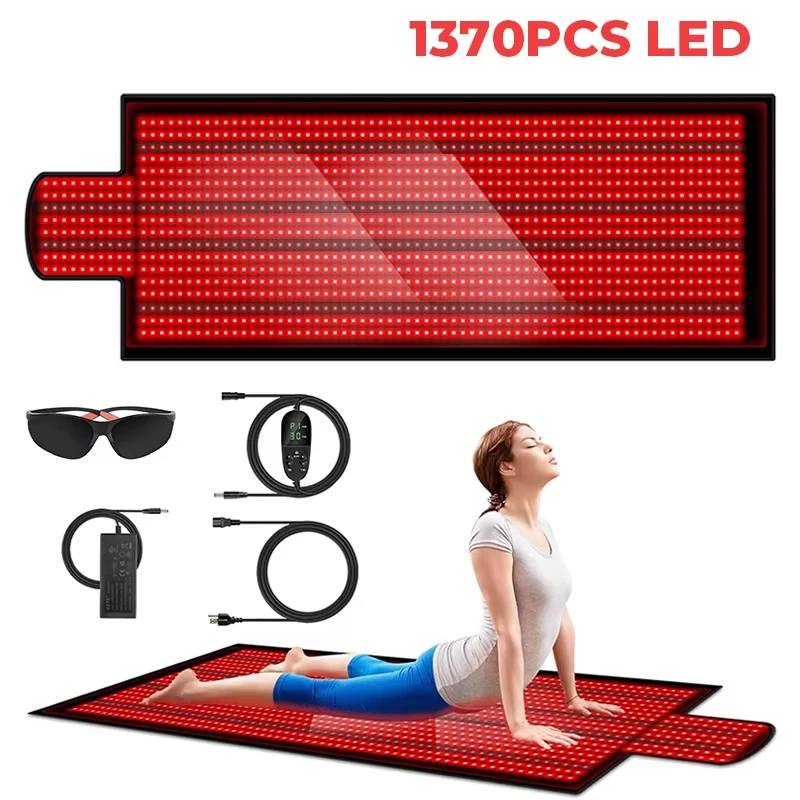
- Mats let you lie down and cover large areas hands-free — useful for a post-session wind-down. See our Blanket vs Mat comparison.
- Belts and wraps target a specific area and stay on while you move around, which suits a pre-workout window better.
- Full-body setups are covered in our Full Body Red Light Therapy at Home guide.
If joint comfort is part of what you're managing alongside training, our Red Light Therapy for Joint Comfort article looks at what the research says there specifically.
Bottom Line
Ask ten sources whether to use red light therapy before or after a workout and most will tell you "before" without qualification. The research does lean that way — but it also shows the effect varies by population and by which outcome you measure, and it isn't consistent across every study.
Treat it as a supporting habit within a training routine, keep expectations realistic, stay consistent, and don't assume longer sessions produce bigger results. For the wider picture on what red light therapy is and isn't well-supported for, see our Red Light Therapy Benefits guide.
FAQs
Is red light therapy better before or after a workout? Most published research has focused on pre-exercise use, and a 2024 meta-analysis found benefits for muscle endurance and strength recovery. However, results vary by population and outcome measured, so it isn't a universal answer.
How long before a workout should I use it? Study protocols typically apply light around 5–20 minutes before exercise, though this varies by device and dose. Follow your device's own guidance.
Can I use it both before and after? Some people do, but keep the biphasic dose response in mind — more total exposure doesn't reliably mean better results, and exceeding the optimal dose can reduce the effect.
Does it work for everyone? No. One meta-analysis found pre-exercise application effective in athletes and sedentary individuals but not in physically active non-athlete populations. Individual results vary.
How often should I use it for training? Consistency over weeks matters more than any single session. Most routines run several times per week — check your device's recommended frequency.
This device is a general wellness product and is not intended to diagnose, treat, cure, or prevent any disease. Individual results vary. If you are pregnant, photosensitive, taking light-sensitising medication, or have a diagnosed health condition, check with a health professional before use.