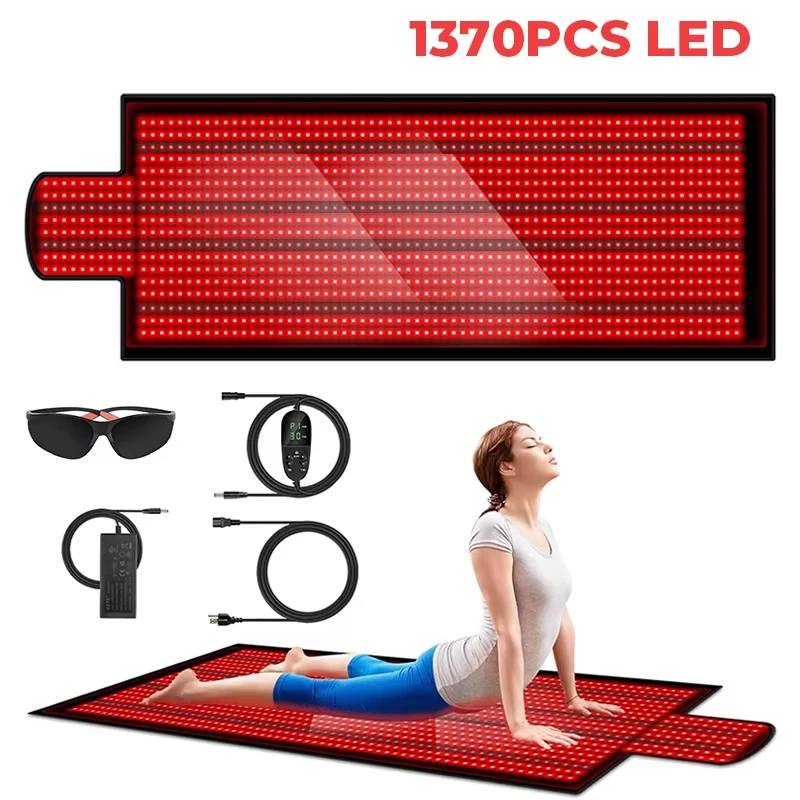
Photobiomodulation is the scientific term for what most people know as red light therapy. If you've searched the word, you've probably landed on either a dense research paper or a product page that uses it as a buzzword without explaining anything. This article sits in between: the actual science, explained properly, without overselling what it establishes.
(If you want the simplified, jargon-free version instead, our What Does Red Light Therapy Do? article covers the same ground in plain English.)
What Photobiomodulation Means
Photobiomodulation (PBM) refers to the use of red and near-infrared light to influence cellular function. Breaking the word down: photo (light), bio (living tissue), modulation (adjusting or influencing). Light influencing biology.
The term replaced older names for the same field. For years this was called low-level laser therapy (LLLT) or cold laser therapy — terminology that became inaccurate once LEDs, not just lasers, became the standard delivery method. "Photobiomodulation" was adopted as the more precise umbrella term, and in 2015 the U.S. National Library of Medicine added it as an official MeSH indexing term for medical literature, which is a reasonable marker of when the field consolidated around the name.
Importantly, PBM is defined by using non-thermal, non-ionising light — meaning it doesn't work by heating tissue, and it doesn't carry the DNA-damaging energy that UV light does. That's a distinction we cover in more depth in Does Red Light Therapy Cause Cancer?.
The Core Mechanism: Cytochrome c Oxidase
Here's the part that actually explains why red light does anything at all.
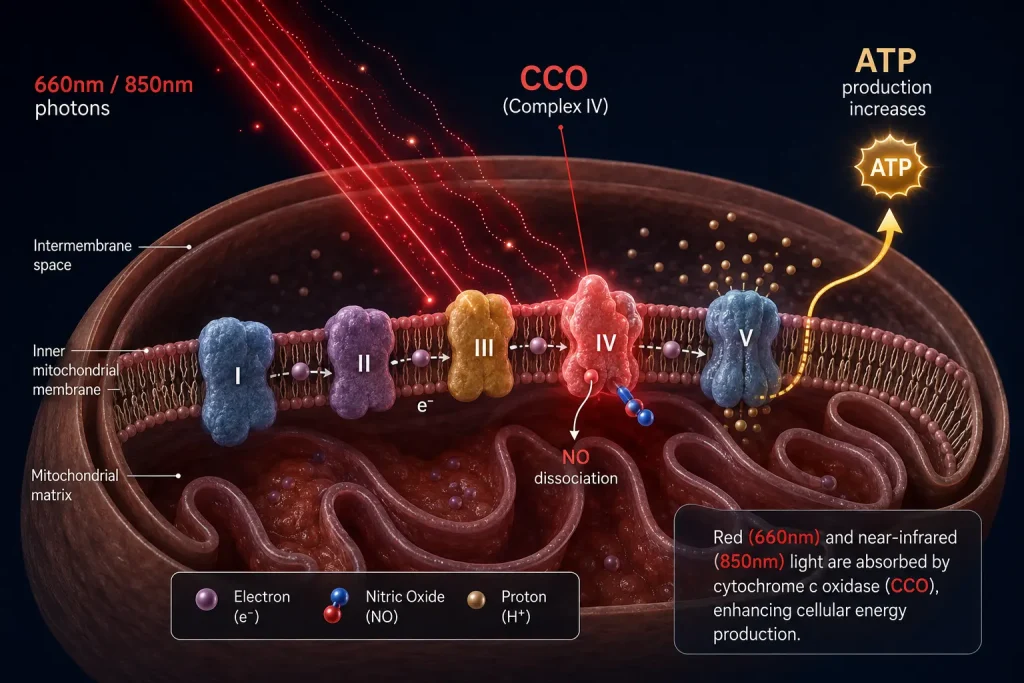
Inside your cells, mitochondria run a process called the electron transport chain to produce ATP — the molecule cells use as energy. The final enzyme in that chain is cytochrome c oxidase (CCO), sometimes written as complex IV. Its normal job is transferring electrons to oxygen, producing water, and contributing to the proton gradient that ATP synthesis depends on.
CCO is also the primary photoreceptor for photobiomodulation. It contains copper and heme centres that absorb light in specific ranges — which is exactly why red (roughly 600–700nm) and near-infrared (roughly 760–940nm) wavelengths are the ones used, rather than any light at all. These wavelengths happen to match what CCO absorbs.
The proposed sequence, as described in the research literature:
- Red or near-infrared photons are absorbed by CCO in the mitochondria.
- Under conditions of cellular stress or low oxygen, nitric oxide can bind to CCO and inhibit its activity. Absorbed photons are thought to dissociate this inhibitory nitric oxide.
- With that inhibition released, mitochondrial membrane potential rises, oxygen consumption increases, and ATP production is enhanced.
- Signalling molecules released in this process — including reactive oxygen species and nitric oxide — go on to influence broader cellular activity.
This is the mechanism referenced across most serious PBM literature. It's worth noting that researchers themselves describe the full picture as still incompletely understood — the CCO photoreceptor role is well-supported, but the downstream chain of effects is an active research area rather than settled science.

The Biphasic Dose Response
This is the single most practically useful concept in PBM research, and it's why "more light is better" is wrong.
PBM shows a biphasic dose response: as the light dose increases, the response increases up to a maximum point — but past that point, the response diminishes, disappears, and at very high doses can become inhibitory. More is not better. There's a window, and exceeding it isn't neutral.
This is the actual scientific reason behind the manufacturer guidance on session length and distance that everyone tends to treat as arbitrary. It isn't — going far beyond a recommended session time doesn't scale up any benefit, and the research suggests it can work against you. Our How to Use Red Light Therapy at Home guide covers the practical side of this.
Why Wavelength and Delivery Matter
Because the mechanism depends on specific absorption ranges, not all light devices are equivalent:
- Wavelength must fall within the ranges CCO actually absorbs — red and near-infrared, not arbitrary colours.
- Irradiance (light output, typically mW/cm²) determines how much energy reaches tissue.
- Time and distance combine with irradiance to determine total dose — which brings you back to the biphasic window above.
Near-infrared penetrates deeper into tissue than visible red, which is why many devices combine both rather than using one alone.

What PBM Research Does and Doesn't Establish
Being honest about this matters more than overselling it:
Reasonably well-established: the CCO photoreceptor mechanism, the biphasic dose response, the non-ionising and non-thermal nature of the light, and that red/near-infrared wavelengths interact with cellular energy processes in a measurable way.
Still developing: much of the research on specific outcomes uses laboratory models, animal studies, or small human trials. Study protocols vary widely in wavelength, dose, and duration, which makes results hard to compare directly. Long-term data on consumer at-home device use specifically is limited.
Not established: that PBM treats, cures, or prevents any medical condition. At-home consumer devices — including Alpha's — are general wellness products, not registered medical devices in Australia. Understanding the mechanism doesn't change that classification, and no amount of interesting science makes a wellness device a treatment.
For a grounded look at what people actually use red light therapy for, see our Red Light Therapy Benefits guide.
FAQs
Is photobiomodulation the same as red light therapy? Effectively yes — photobiomodulation is the scientific term, red light therapy is the consumer term for the same underlying process.
What is cytochrome c oxidase? It's the final enzyme in the mitochondrial electron transport chain, and the primary light-absorbing molecule (photoreceptor) thought to be responsible for photobiomodulation effects.
Why is more light not better? PBM follows a biphasic dose response — the response increases up to an optimal dose, then diminishes beyond it, and very high doses may become inhibitory rather than beneficial.
Is photobiomodulation the same as LLLT? Low-level laser therapy (LLLT) is the older name for the same field. The terminology shifted to photobiomodulation because LEDs, not just lasers, are now standard.
Does understanding the mechanism mean the health claims are proven? No. The mechanism has reasonable support, but that's separate from proving specific health outcomes — and consumer devices are general wellness products, not medical treatments.
This device is a general wellness product and is not intended to diagnose, treat, cure, or prevent any disease. Individual results vary. If you are pregnant, photosensitive, taking light-sensitising medication, or have a diagnosed health condition, check with a health professional before use.