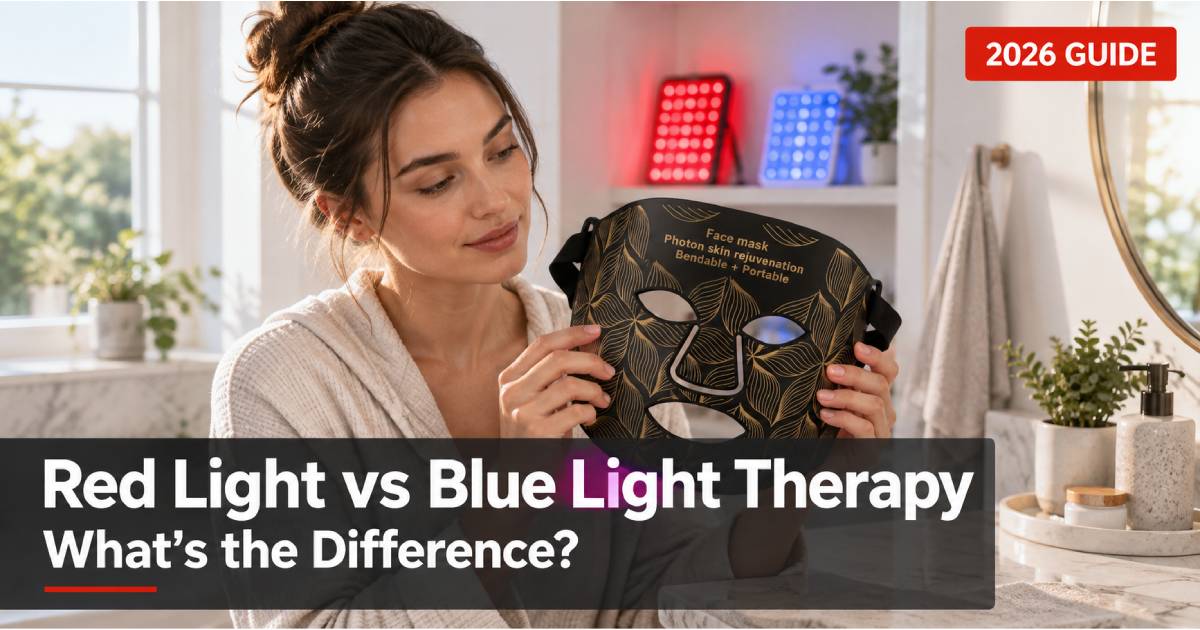
Red light. Blue light. Near-infrared. Green, yellow, purple.
Shop for an LED face mask for five minutes and it starts to look as though more colours must mean a better device.
They don't.
Red and blue light sit in different parts of the visible spectrum, are used for different reasons and have different bodies of research behind them. A seven-colour mask isn't automatically more useful than a device built around one or two clearly stated wavelengths.
So before comparing the number of colour buttons, it helps to understand what red and blue light actually mean.
The short version
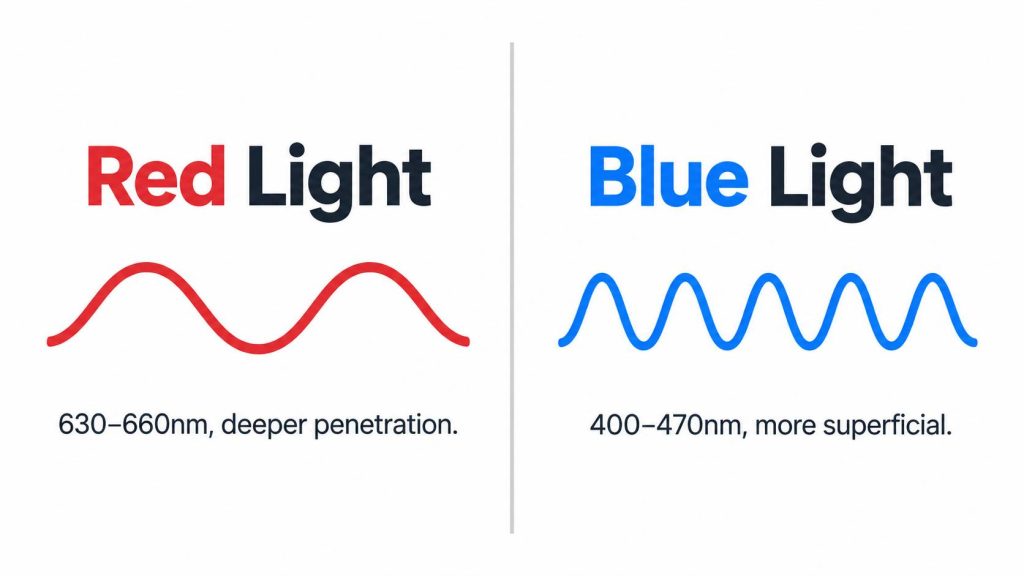
Red light uses longer visible wavelengths, commonly in the 630–660nm area in LED devices.
Blue light uses shorter visible wavelengths, commonly around the low-to-mid 400nm range.
They're not interchangeable settings.
Blue-light research is heavily concentrated on acne-related applications, while red and near-infrared light appear across a much broader photobiomodulation research field.
That doesn't make one colour universally “better”. It means the right comparison depends on why you're buying the device in the first place.
Red vs blue light at a glance
| Red light | Blue light | |
|---|---|---|
| Typical wavelength range in devices | Roughly 630–660nm | Roughly 400–470nm |
| Visible to the eye | Yes | Yes |
| Common LED-mask research area | Skin appearance / photobiomodulation | Acne-focused research |
| Penetration | Deeper than blue light | More superficial |
| Often paired with | Near-infrared | Red light |
| Does colour alone tell you device quality? | No | No |
The actual wavelength should be stated in nanometres (nm). “Red mode” or “blue mode” without a wavelength tells you less than a listing that gives the numbers.
What red light is
Red light is visible light at the longer-wavelength end of the visible spectrum.
In at-home devices you'll often see numbers such as 630nm or 660nm.
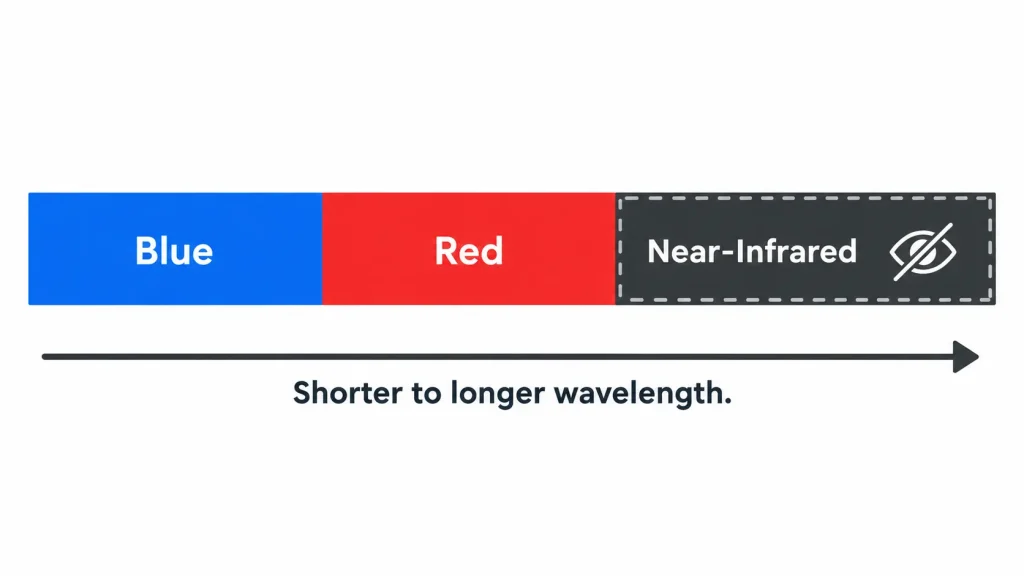
Red light is also frequently paired with near-infrared (NIR) light, commonly around 810–850nm. Near-infrared is outside the visible range, so you may not see it glowing even when the LEDs are operating.
That's why a device advertising “red + NIR” is doing something different from a simple multicolour cosmetic lamp.
For a deeper explanation, see our 660nm and 850nm red light therapy buyer's guide.
What blue light is
Blue light uses shorter wavelengths than red light.
In clinical and home-device research around acne, blue LEDs commonly sit around the 400–450nm region.
This is also why blue light shouldn't simply be described as “red light therapy, but blue”.
It's a separate wavelength range with a different research focus.
If you're looking at blue light because you have persistent or diagnosed acne, that's also where the distinction between a cosmetic routine and medical advice matters. An LED mask isn't a substitute for seeing a GP or dermatologist about a skin condition.
Why red and blue are sometimes combined
You'll find plenty of face devices offering both.
There's a reason the combination appears frequently: research on home LED devices for acne has included blue-only, red-only and combined red-and-blue protocols.
That doesn't mean every red-and-blue mask is equivalent.
The study result from one device doesn't automatically transfer to another product that simply happens to glow the same colour.
You still need to know:
- the actual wavelengths;
- the output;
- session duration;
- distance from the skin;
- recommended frequency;
- what claims the manufacturer is making.
The colour button is only the beginning of the specification.
Does blue light penetrate as deeply as red light?
No. Shorter-wavelength blue light is absorbed more superficially than longer red and near-infrared wavelengths.
That's one reason their research and intended applications differ.
But don't turn “deeper” into “better”.
Depth only matters in relation to what you're trying to do. Buying a device because one wavelength penetrates further makes little sense if that isn't relevant to your intended routine.
What about near-infrared?
This is the part most “red vs blue” comparisons leave out.
Near-infrared isn't red light and it isn't blue light. It's a longer wavelength just beyond what the human eye can see.
Many red light therapy products combine visible red with NIR rather than offering a rainbow of visible colours.
Alpha's larger-area devices, for example, use 660nm red and 850nm near-infrared.
If you're shopping specifically for a red light therapy device rather than a general multicolour beauty mask, these wavelength numbers are worth paying more attention to than the total number of colour settings.
Are seven colours better than two?
Not automatically.
This is one of the easiest marketing numbers to overvalue.
A listing may advertise:
- red
- blue
- green
- yellow
- purple
- cyan
- white
That looks impressive on a product graphic.
But ask a more useful question: what exact wavelengths does the manufacturer state, and why are those wavelengths included?
If five of seven colours are described only with vague beauty claims and no specifications, the colour count hasn't told you much.
A well-documented device with clearly stated wavelengths is easier to evaluate than one whose main specification is “7 colours”.
What should you check in an LED mask?
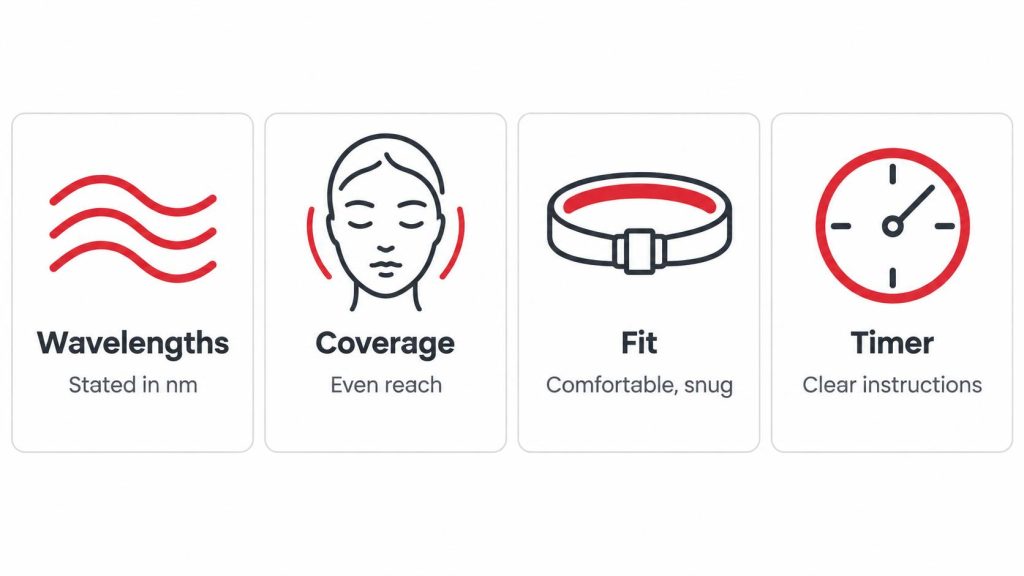
1. Actual wavelengths
Look for nanometre values.
“Red LED” isn't as useful as “660nm red”.
“Blue LED” isn't as useful as a stated blue wavelength.
2. Face coverage
Look at where the LEDs actually sit around the forehead, cheeks, nose and jaw rather than counting the total LEDs on the box.
If neck coverage matters, check that separately. Our LED neck mask Australia guide explains what to look for below the jawline.
3. Fit
A mask with impressive specifications that you hate wearing isn't a useful device.
Flexible silicone, adjustable straps, controller placement and overall weight all affect whether you'll realistically use it several times a week.
4. Timer and instructions
The manufacturer should tell you how long a session lasts and how frequently the device is designed to be used.
Don't build your routine by copying the session length from another brand.
We've covered frequency separately in our guide to how often you should use red light therapy.
5. Australian support
For Australian buyers, check:
- AU-compatible power setup;
- local warranty;
- local return address;
- dispatch location;
- who actually handles support.
Those details become much more important than another colour setting if something fails after four months.
A note on medical claims in Australia
This matters particularly with acne-related marketing.
In Australia, the claims made for a product can affect how it is regulated. A cosmetic appearance claim isn't necessarily the same thing as a claim to diagnose, prevent or alleviate a medical condition.
So if an LED mask is making specific therapeutic claims, don't assume “it's only a beauty device” and move on.
Check what the seller is actually claiming and, where relevant, whether the device is included on the Australian Register of Therapeutic Goods.
We've covered the terminology in our guide: is red light therapy TGA approved in Australia?.
Alpha's devices are sold as general wellness and cosmetic products. We don't position them as medical devices or make disease-treatment claims.
So which one should you choose?
Don't start with the colour.
Start with the reason you're shopping.
If you're looking specifically for a red and near-infrared home routine, compare the stated red/NIR wavelengths, coverage, fit and usability.
If you're specifically researching blue light because of acne, look at the evidence and specifications for that purpose and speak with a dermatologist or GP if you're dealing with a diagnosed or persistent skin condition.
And if you're looking at a seven-colour mask simply because seven sounds better than two, ignore the colour count for a moment and read the wavelength specifications.
That's usually where the useful comparison starts.
Where Alpha fits
Alpha focuses on red and near-infrared at-home devices across targeted and larger coverage formats.
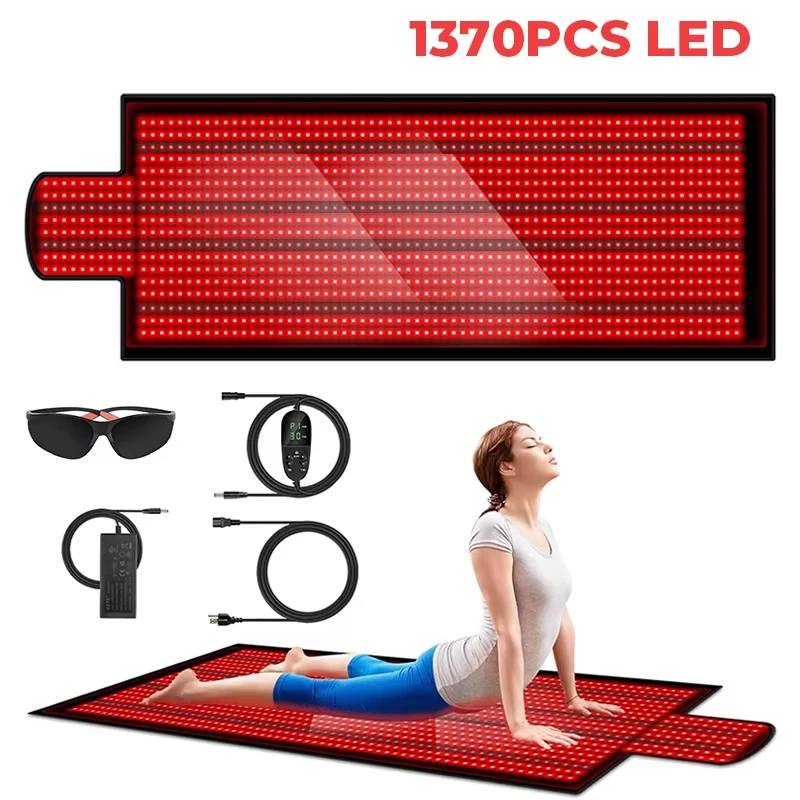
Our range includes a Face & Neck LED Mask, a Red Light Therapy Belt and a full-body Red Light Therapy Mat.
If you're not sure which format suits the area you actually want to cover, start with our guide to choosing a red light therapy device.
FAQ
Is blue light the same as red light therapy?
No. Red and blue light use different wavelength ranges. Blue-light research is commonly associated with acne-focused applications, while red and near-infrared wavelengths are used across the broader photobiomodulation field.
Is red light or blue light better?
Neither is universally better. They use different wavelengths and are studied for different purposes. Choose according to your intended use and the specifications of the actual device rather than colour alone.
Can an LED mask have both red and blue light?
Yes. Many LED masks offer both wavelengths, and red-and-blue combinations have also been studied. That doesn't mean every combined mask has the same output or evidence, so check its actual specifications.
Does blue light penetrate as deeply as red light?
No. Shorter-wavelength blue light is absorbed more superficially than longer red light, while near-infrared wavelengths reach further still.
Are seven-colour LED masks better?
Not necessarily. The number of colours doesn't establish device quality. Clearly stated wavelengths, output, coverage, fit and usable session design are more useful specifications.
What do 660nm and 850nm mean?
They're wavelengths. 660nm is visible red light, while 850nm is near-infrared and mostly invisible to the human eye. The two are commonly paired in red and near-infrared devices.
Disclaimer
Alpha Red Light Therapy devices are general wellness and cosmetic products. They are not intended to diagnose, treat, cure or prevent any disease. Information on this page is general in nature and is not medical advice. Individual results vary. If you have a diagnosed skin condition, are pregnant, or take photosensitising medication, speak with a qualified health professional before starting any light-based routine.