Search “red light therapy panel vs mask” and you’ll find strong opinions in mask reviews and mask vs panel Reddit threads. This guide sets out the practical differences and what to check before buying in Australia.
Before you read on: the findings mentioned below come from specific study devices, settings and groups of participants. They may not apply to any particular device or person, and no format can promise an outcome.
This is general information, not medical advice, and it doesn’t recommend any product. For advice about your own skin or health, please talk with your GP or a dermatologist.
Face only, or face and body?
- Masks are shaped to sit on or close to the face. Some include a neck piece. They suit people whose interest is face-only.
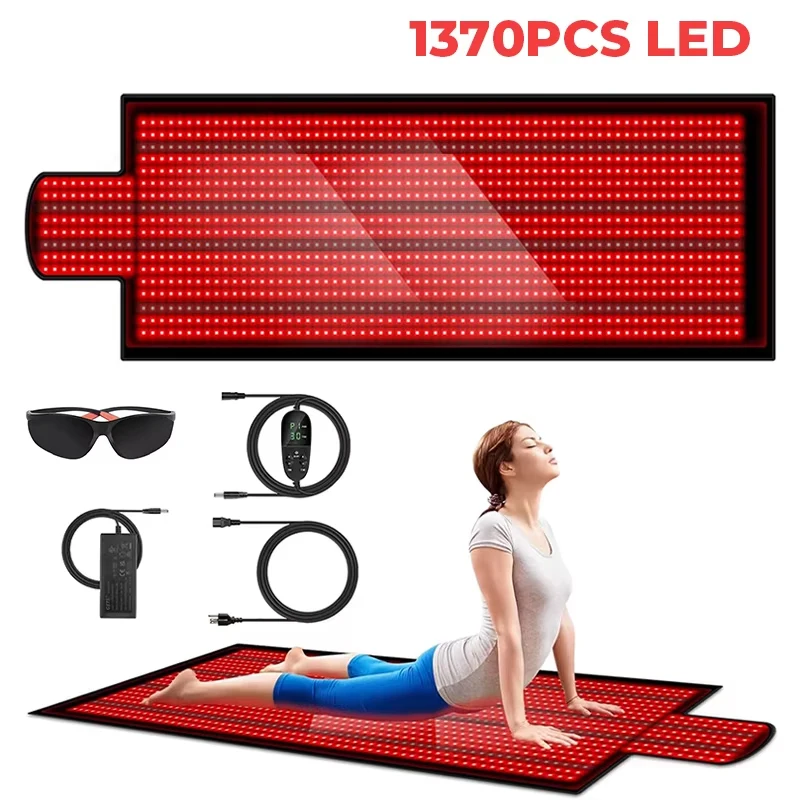
- Panels range from small tabletop units to a full body panel on a panel stand. They can be positioned for the face, or for larger areas such as the back or legs.
A 2026 systematic review of at-home LED devices for the face (8 studies, 365 people) noted that most consumer devices are designed as wearable masks, and that comparative data were limited.[4] So there’s no clear study evidence that one format is “better”.
How output differs at the distance you’d actually use
The key spec is irradiance, which is light power per area in mW/cm² at a stated distance.[3] As a general principle, light spreads out as it travels, so the further your skin is from the source, the less light reaches each square centimetre.
So raw output alone is a poor comparison:
- Masks generally have lower output. In a US media article, one dermatologist estimated masks at about 5–25 mW/cm² on average.[5] For reference, the mask used in a 2025 trial was described as having a maximum of 10 mW/cm² at each of its two wavelengths.[2]
- Panels generally have higher output. The same dermatologist estimated panels at about 40–60 mW/cm², and noted that the energy reaching the skin also depends on distance from the light source.[5] These are a media-quoted estimate, not study measurements.
A mask’s lower output is partly offset by sitting right against or very near the skin. A panel’s higher output is measured at a set distance, and if you sit further back than that, less light reaches you. Either way, the useful comparison is irradiance at the distance you’ll actually use. For more on reading these numbers, see how to choose a red light therapy device.
Mask vs panel at a glance
| Mask | Panel | |
|---|---|---|
| Coverage | Face (sometimes neck) | Face, or larger body areas depending on size |
| Typical distance | On or very near the skin | Set distance in the instructions, often with a panel stand |
| Output | Generally lower (media estimate ~5–25 mW/cm²)[5] | Generally higher (media estimate ~40–60 mW/cm²)[5] |
| Hands-free | Yes, worn | Yes, once positioned |
| Setup | Minimal | More (space, positioning, power) |
| Eye considerations | Light very close to the eyes | Bright light at a distance |
Table rows other than the cited output estimates are general and illustrative.
What the research has looked at
In a randomised, double-blind, sham-controlled trial published in 2025, Park and colleagues enrolled 60 adults of Asian descent aged 30–65 (about 93% women). The trial was run at two sites. One group used a home mask combining 630 nm and 850 nm light. The comparison group used a sham mask with much lower red output. Both used their mask for 9 minutes, 5 times a week, for 12 weeks, with a final check at 16 weeks.[2]
Independent raters and investigators recorded statistically significant differences in crow’s feet grading scores between the groups at 8, 12 and 16 weeks.[2] Limits:
- It was one trial with 59 people analysed and a short follow-up.
- Participants’ use of other skin care couldn’t be ruled out.
- A device company funded it. The authors state that the design, analysis and writing were independent of the funder.[2]
- Participants’ own ratings of overall improvement did not differ between the groups, according to the 2026 review.[4]
The changes recorded in studies like these were modest and relied on regular use over weeks.[2][4]
Cheap vs premium mask: what to check beyond price
Red light therapy masks in Australia are sold through beauty, department, electronics and discount retailers. Price alone tells you little. Instead, check:
- Published specs at a stated distance. Look for wavelengths and irradiance clearly listed. A 2026 product guide suggests looking for sellers that list wavelengths, disclose irradiance and dose, and link to published research.[1]
- Device-specific evidence. The same guide notes that many trials don’t name the product they tested, so a study on “an LED mask” may not be about the one you’re considering.[1]
- Fit and eye openings. Check the fit and how close the LEDs sit to your eyes.
How to read mask “before and after” photos
Mask before and after photos are easy to misread. Check for:
- Lighting. Brighter or softer light can smooth skin’s appearance on its own.
- Angle and distance. Small changes in head position or camera distance change how lines look.
- Makeup, skin care and hydration. Moisturiser, makeup or even time of day can make a difference.
- No comparison group. A single person’s photos can’t show what would have happened without the device. Trials like Park and colleagues’ used a sham group for this reason.[2]
- Selection and editing. You may be seeing only the most flattering examples.
Which is easier to use consistently?
Studies ran for weeks with regular sessions,[2][4] so ease of use matters.
- Masks need little setup and are hands-free. The 2026 review authors suggested wearable masks may improve convenience and consistency, and that panels may deliver higher cumulative doses, but noted that comparative adherence data were lacking.[4] Some people find masks warm or heavy.
- Panels need space, a stable position (a stand helps) and keeping to the stated distance. Once set up, some people find them easy to use while reading or relaxing.
Always follow your device’s instructions on session length and frequency.
Eye safety
Whichever format you choose, keep your eyes closed or wear suitable goggles, and follow the device’s eye-safety guidance. If you have an eye condition or take medication that increases light sensitivity, check with your GP, optometrist or eye doctor first.
What to check before buying in Australia
- The ARTG listing, if a therapeutic claim is made. If a device is promoted for a therapeutic purpose, look up its ARTG entry. See our guide to TGA and ARTG.
- Published specs at a stated distance. See how to choose a red light therapy device.
- Eye protection. Check whether goggles are supplied and what the instructions say.
- Warranty and returns. Under the Australian Consumer Law, products come with automatic consumer guarantees. Warranties are extra promises on top of these and can’t take them away.[6] If a product has a major problem, you can choose a refund or replacement. Businesses don’t have to offer a refund if you simply change your mind, unless they have a change-of-mind policy, which they must then follow.[7] Read the returns policy before you buy.
FAQ
Is a red light therapy mask or panel better? Neither has been shown to be better, and comparative data were limited.[4] A mask suits face-only use; a panel offers wider coverage but needs more setup.
Do red light therapy masks work? A 2025 sham-controlled trial of one 630/850 nm mask (59 people analysed) recorded modest differences in rater-scored crow’s feet after regular use over 12 weeks. Its findings may not apply to other masks or people.[2]
Why does a mask have lower output than a panel? Masks generally have lower irradiance than panels,[5] but sit very close to the skin, while panel output is measured at a set distance.
What should I check before buying in Australia? Check the ARTG entry if a therapeutic claim is made, specs at a stated distance, eye protection, the warranty and returns policy, and your consumer guarantee rights.[6][7]
For personal advice about whether red light therapy suits your skin, please talk with your GP or a dermatologist.
Related reading on our blog
- How to choose an at-home red light device (mask, belt or mat)
- Red light therapy mask for face and neck: a complete routine
- Face and neck red light therapy mask routine at home
Sources
- Spongberg CV, Stack ER, Aprigliano C, Grinis D, Sawicki S, Elway M. What to look for in red light therapy: a product guide backed by science. Cureus. 2026. https://doi.org/10.7759/cureus.105378 (PMC: https://pmc.ncbi.nlm.nih.gov/articles/PMC13085462/)
- Park SH, Park SO, Jung JA. Clinical study to evaluate the efficacy and safety of home-used LED and IRED mask for crow’s feet: a multi-center, randomized, double-blind, sham-controlled study. Medicine (Baltimore). 2025;104(7):e41596. https://doi.org/10.1097/md.0000000000041596
- de Freitas LF, Hamblin MR. Proposed mechanisms of photobiomodulation or low-level light therapy. IEEE Journal of Selected Topics in Quantum Electronics. 2016;22(3). https://doi.org/10.1109/JSTQE.2016.2561201
- Das RK, Thayer WP, Kubiak CA, et al. Efficacy and safety of at-home light-emitting diode photobiomodulation for facial rejuvenation: a systematic review. Aesthetic Plastic Surgery. 2026. https://link.springer.com/article/10.1007/s00266-026-06333-w
- Espinal J. Should you use a red light mask or a panel? We asked dermatologists. TODAY (US media article, updated 22 September 2026). https://www.today.com/shop/red-light-therapy-mask-vs-panel-rcna343126
- ACCC. Warranties. https://www.accc.gov.au/consumers/buying-products-and-services/warranties
- ACCC. Repair, replace, refund, cancel. https://www.accc.gov.au/consumers/problem-with-a-product-or-service-you-bought/repair-replace-refund-cancel