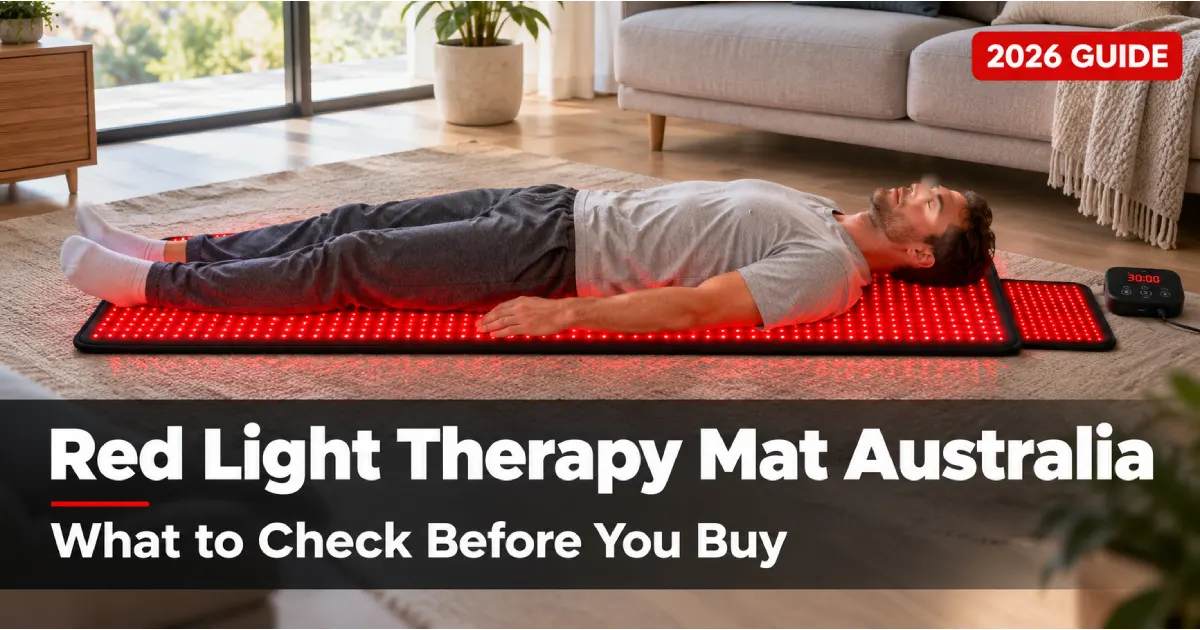
A full-body red light therapy mat is the simplest way to get light across a large area at home. No panel to mount on a wall, no floor stand to store, no standing still for twenty minutes. You unroll it, lie down, set the timer.
The catch is that the Australian market is full of listings that look almost identical — same stock photos, same big LED numbers, same vague "red light" description with no specifications behind it. This guide covers what actually separates one mat from another, and what to check before you buy here.
First: "mat" and "blanket" usually mean the same thing
This trips up a lot of buyers, so it's worth clearing up early.
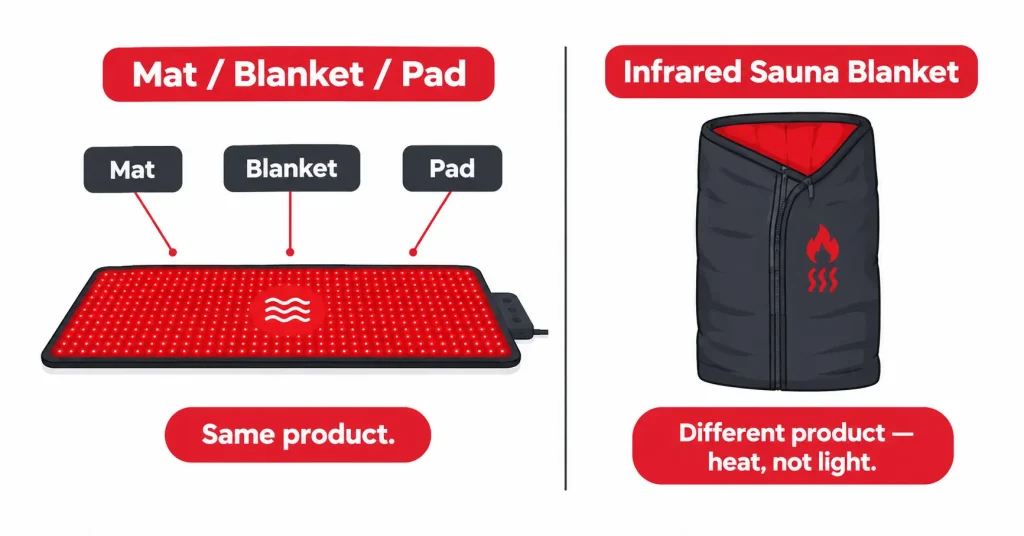
Search for a full-body red light device and you'll see the same product listed as a mat, a blanket, a pad and a wrap — often by the same seller, sometimes in the same product title. In most cases it's one thing: a large flexible LED panel you lie on, or fold over the area you're targeting.
A genuinely different product is the infrared sauna blanket, which zips around you and works by generating heat rather than by emitting red and near-infrared light. That's a separate category with a separate purpose — don't buy one expecting the other. We've explained the difference here: infrared sauna vs red light therapy.
So if you searched "red light therapy blanket Australia" and landed here: you're in the right place. The rest of this guide is about full-body LED mats.
The five things that actually matter
1. Coverage area — measure it, don't eyeball it
This is the biggest real difference between a cheap mat and an expensive one, and it's the spec most listings bury below the marketing copy.
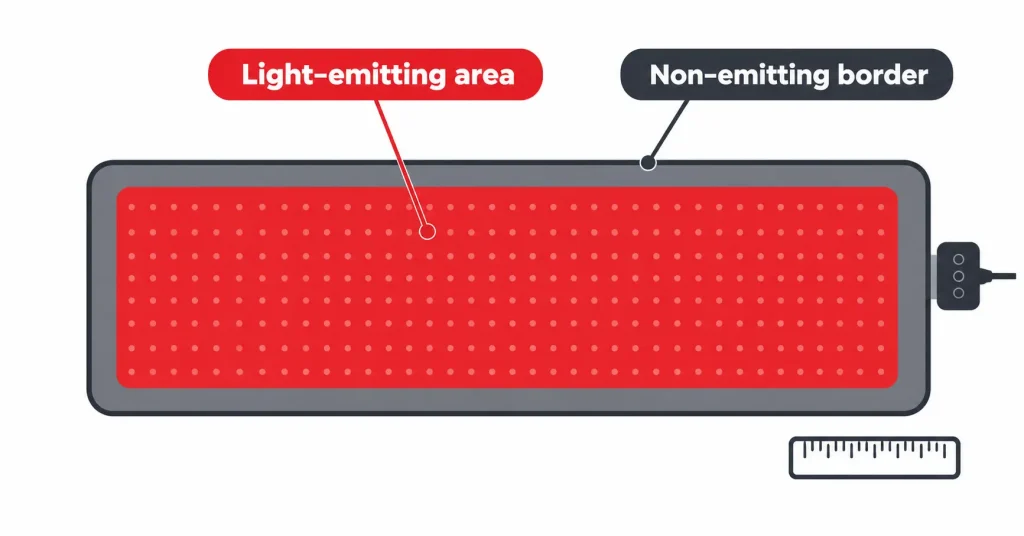
Check the stated dimensions in centimetres, then hold them against your own height. A mat that reaches from your shoulders to your knees is a genuinely different product from one that stops at your hips — even if both photos look the same on a model.
Also check whether the light-emitting area matches the overall size. Some mats have wide non-emitting borders, so the usable coverage is noticeably smaller than the figure on the box.
2. Wavelengths — the numbers, not the colour
Most of the research interest in this space sits on red light in roughly the 630–660nm range and near-infrared around 810–850nm. A good listing states both figures explicitly.
Red light is visible. Near-infrared mostly isn't — which means a mat can look dimmer while still emitting NIR. Don't judge output by how bright it looks in a photo.
If a listing says "red light therapy" with no nanometre figures anywhere, that's a real information gap, not a minor omission. Our 660nm and 850nm buyer's guide explains why those two numbers come up so consistently.
3. LED count — useful, but easy to inflate
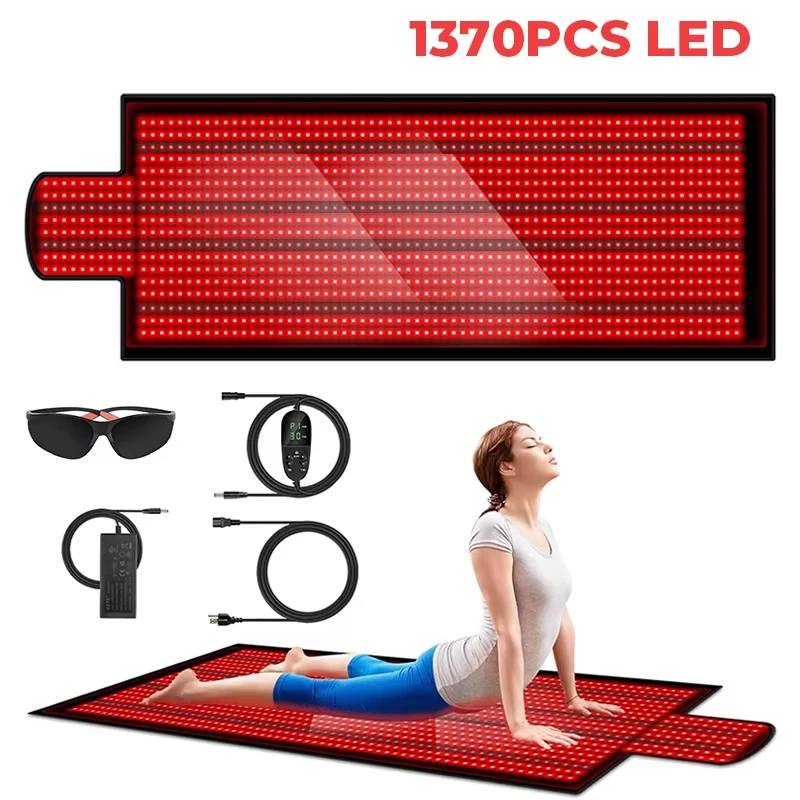
LED count tells you something about density, but it's the easiest number for a seller to make sound impressive. 1,370 LEDs spread across a full-body mat is a very different product from 1,370 LEDs packed into a small pad — and both can be advertised with the same headline number.
What's more useful: LED count relative to coverage area, and whether the diodes are multi-chip (emitting both red and near-infrared from the same bead) or single-wavelength. A listing that explains its LED layout is telling you more than one that just quotes a big figure.
4. Controller, timer and modes
Look for a controller with a clear session timer that shuts the unit off automatically, adjustable intensity, and the option to run red and near-infrared separately or together. Some mats also offer pulse modes at different frequencies.
Adjustable intensity matters more than people expect — starting lower and building up is sensible with any new device.
5. Materials and cleaning
You'll be lying directly on this thing for 10–20 minutes at a time, so the boring details count:
- Surface material — leather-look, TPU and similar finishes all wipe clean; fabric surfaces don't, as easily.
- Flexibility — can it fold or roll for storage, or does it need to stay flat?
- Storage size — a full-body mat is large. Work out where it lives when it's not in use, before it arrives.
If you want the longer read on sizing and storage for an average Australian home, we've covered that separately: large red light therapy blanket guide for Australian homes.
Mat or belt — which format?
If you're targeting one area rather than your whole body, a belt is cheaper, more portable and easier to use while doing something else. A mat is for whole-body sessions and costs accordingly.
That decision deserves its own comparison rather than a paragraph here: red light therapy belt vs full body mat.
The Australian-specific checks
These are the ones that catch people out, and they're the reason overseas reviews aren't much help.
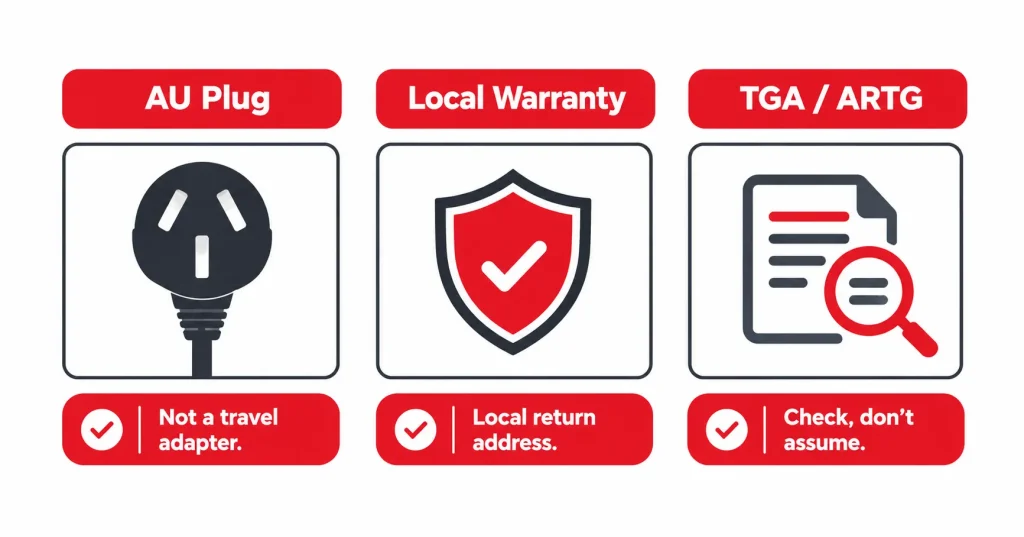
A genuine AU plug. Many of the cheapest listings ship from overseas with a travel adapter in the box rather than a proper Australian plug. For a device you'll leave plugged in regularly, check before ordering.
Local warranty and a local return address. A full-body mat is bulky. If it fails in month five, shipping it overseas can cost more than the repair is worth. An Australian return address is worth more than a longer warranty printed on the listing.
Realistic dispatch. Some "Australian" storefronts drop-ship from overseas with three-week lead times. Check the stated dispatch location.
Claims language. If a listing promises to fix a specific medical condition, treat that as a warning sign rather than a selling point. Australian rules on therapeutic claims are strict, and sellers who ignore them are usually cutting corners elsewhere too.
On that last point, "TGA approved" is used very loosely in this market and is usually wrong. The TGA doesn't "approve" devices — devices making therapeutic claims are included on the Australian Register of Therapeutic Goods (ARTG), and most at-home wellness mats aren't on it at all. Full explainer here: is red light therapy TGA approved in Australia?
To be direct about our own position: Alpha's mat is sold as a general wellness device. It is not an ARTG-registered medical device, and we don't market it as one.
What you'll pay in Australia
Full-body red light mats in Australia generally run from a few hundred dollars at the budget end to well over $1,500 for larger, higher-specification units.
Below roughly $300, be sceptical of the coverage and wavelength claims — that's the price band where the vague listings cluster, and where "1370 LEDs" often turns out to describe a much smaller pad.
Alpha's mat
Our Red Light Therapy Mat is a full-body mat with 1,370 LEDs running 660nm red and 850nm near-infrared, with an adjustable timer and intensity control. It ships from within Australia with local warranty support.
There's also a bundle version that pairs the mat with PHATOIL essential oils if you want both.
Setting realistic expectations
A mat is a routine device, not a one-session change. Sessions typically run 10–20 minutes, and most people find several sessions a week more practical than occasional long ones. Follow the instructions supplied with your specific device rather than a number from a forum.
Results vary between individuals. If you have a diagnosed condition, are pregnant, or take medication that increases light sensitivity, speak to your GP before starting any light-based routine.
FAQ
What is a red light therapy mat? It's a large flexible panel lined with red and near-infrared LEDs that you lie on for a timed session, usually 10–20 minutes, so light reaches a large area of the body at once.
Is a red light therapy mat the same as a blanket? Usually yes — sellers use "mat", "blanket" and "pad" interchangeably for the same flat LED panel. An infrared sauna blanket is a different product: it works by generating heat rather than emitting red and near-infrared light.
How much does a red light therapy mat cost in Australia? Most run from a few hundred dollars to well over $1,500, depending on coverage area, LED density and build quality. Very cheap listings often turn out to be much smaller pads than the photos suggest.
Mat or belt — which should I get? A belt is cheaper and more portable, and suits targeting one area. A mat is for whole-body sessions. If you only ever plan to use it on your back or knees, a belt is the more sensible buy.
Are red light therapy mats TGA approved? Most at-home mats in Australia are sold as general wellness or cosmetic products, not registered medical devices. The TGA doesn't "approve" products — it includes them on the ARTG, which the public can search.
How often should I use one? Manufacturers set their own recommended frequency, so check the manual supplied with your device. Consistency over several weeks generally matters more than the length of any single session.
Disclaimer
Alpha Red Light Therapy devices are general wellness and cosmetic products. They are not intended to diagnose, treat, cure or prevent any disease, and they are not ARTG-registered medical devices. Information on this page is general in nature and is not medical advice. Individual results vary. If you have a diagnosed condition, are pregnant, or take photosensitising medication, speak with a qualified health professional before starting any light-based routine.