
Back pain is one of the most common reasons people search for a drug-free routine — and red light therapy keeps coming up as an option. This guide gives you an honest answer: what a home device can realistically offer, who tends to find it worth trying, and exactly how to use it if you decide to give it a go.
Does Red Light Therapy Actually Help Back Pain?
The honest answer: it can be a genuinely useful part of a routine for many people — but we're not going to hand you a specific percentage or a study we can't stand fully behind.
Red and near-infrared light (photobiomodulation) is a real, active area of academic research, including studies looking at back comfort and mobility. Here's the honest, unglamorous summary: it's a genuinely active field, but study quality varies a lot — different wavelengths, different doses, different devices, different protocols, and different ways of measuring outcomes. Some studies are well-designed. Others are small, short, or use lab equipment that bears little resemblance to a home LED belt or mat used for fifteen minutes before bed.
Look around this category and you'll see very specific numbers attached to red light therapy and back pain — a particular percentage, a particular study, a particular comparison to medication. Some of that traces back to real published research. A lot of it is stretched, cherry-picked, or describes a specific clinical laser protocol, not a home device used casually at home. We'd rather be straight with you about that gap than repeat a number we can't verify.
Where people tend to find it most worth trying:
- General muscle tightness or soreness in the lower back
- Acute strain after activity, lifting, or exercise
- Post-workout or activity-related stiffness
- As part of a broader routine alongside movement and stretching
Where the evidence is more mixed: for chronic, ongoing back discomfort without a clear cause, results vary a lot more between studies, and several researchers have noted that light therapy used entirely on its own — without any accompanying movement — tends to show smaller or less consistent results. In other words: it works best as one part of a broader approach, not a standalone fix.
The bottom line: red light therapy is a reasonable, low-risk addition to a back comfort routine for many people, particularly when it's paired with movement, stretching, or guidance from a physical therapist. It's not a guaranteed fix for every type of back discomfort, and it works best as part of a broader routine — not used alone as a substitute for professional care.
How Does It Work, in Plain Terms?
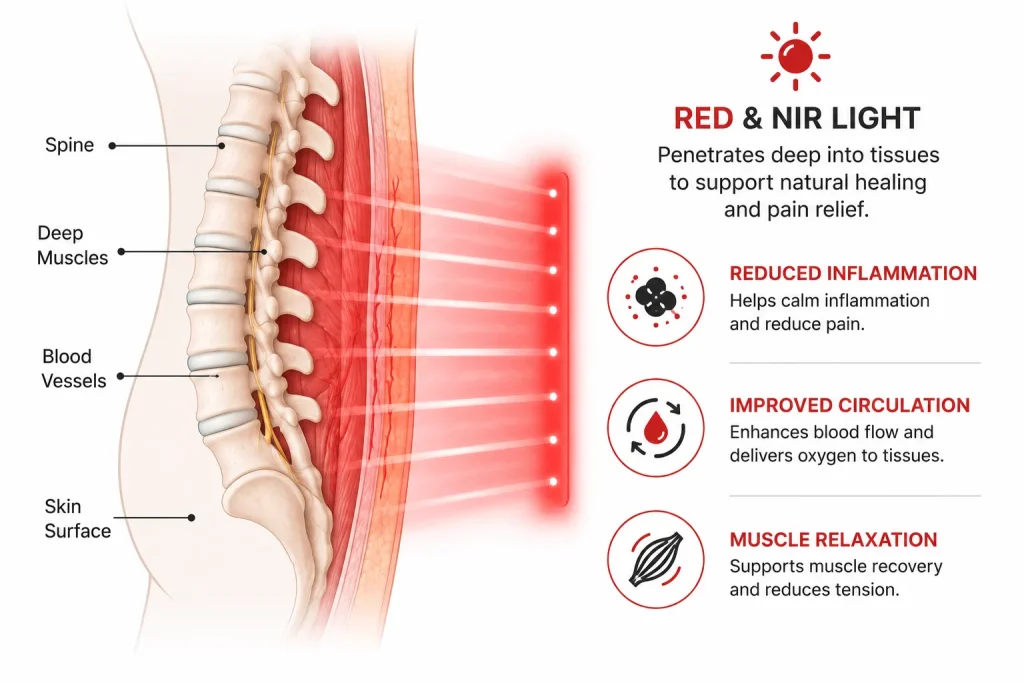
Red and near-infrared light — typically in the 660nm (red) and 850nm (near-infrared) range — is absorbed by mitochondria in your cells, which is associated with increased ATP (cellular energy) production. For a back comfort routine specifically, people generally report noticing two things:
1. A sense of warmth and relaxation — many people describe the treated area feeling looser and less tense after a session, which is consistent with the light's association with local circulation.
2. Easier movement afterward — many users report that treated muscles feel more willing to move after a session. This doesn't mean you should immediately push into hard exercise — but it can make it easier to gently stretch and gradually rebuild strength, which is where the real long-term benefit of a comfort routine tends to come from.
We're intentionally not attaching a specific biological claim (like a named effect on a specific marker) to this — the research field is genuinely still developing, and we'd rather describe what people generally experience than assert a mechanism we can't fully stand behind for a home device.
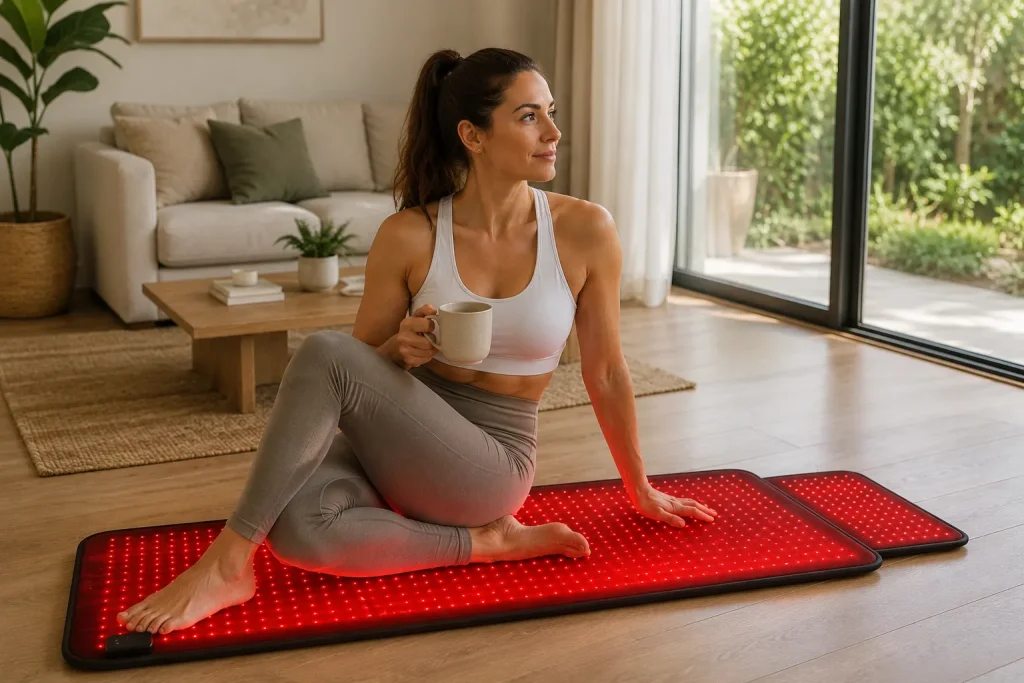
Best Practice: Pair It With Movement, Not Instead of It
This is the single most consistent takeaway across the research: light therapy tends to fit best into a routine alongside movement or stretching, rather than used passively on its own.
If you're building a back comfort routine around red light therapy, a sensible structure looks like this:
- Use your device — belt or mat — for 10–20 minutes
- Follow with gentle movement — light stretching, walking, or core activation exercises
- Repeat consistently — a realistic starting point is a few sessions per week, adjusted to what fits your routine
This pairing makes practical sense — a warmer, looser muscle is generally easier to move, and movement is what builds the lasting strength and mobility that actually helps prevent recurring stiffness.
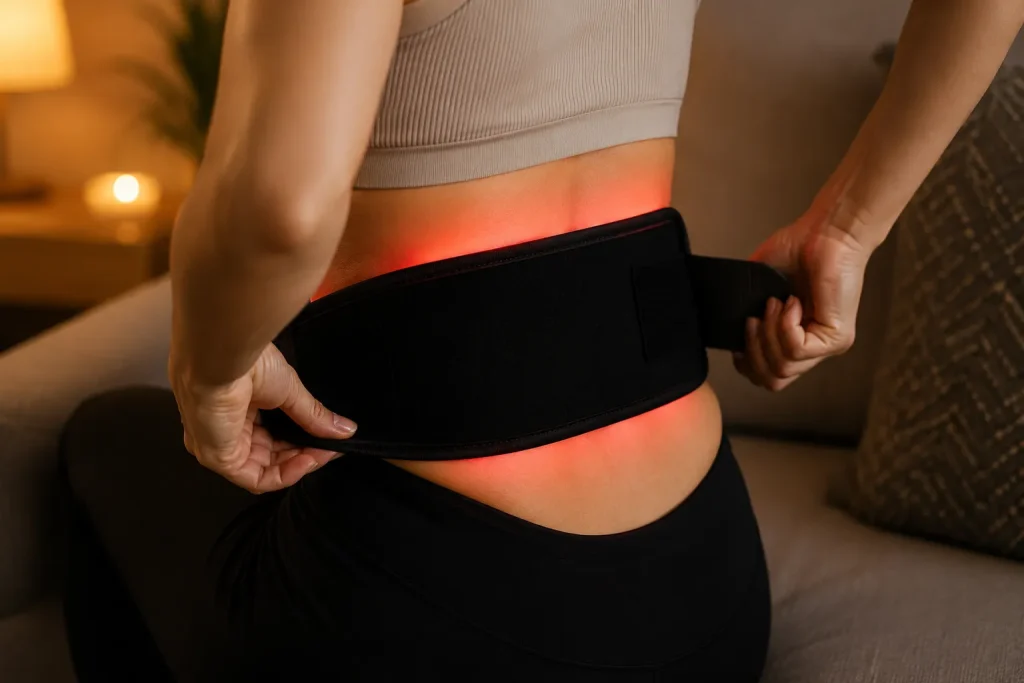
How to Use Red Light Therapy for Back Comfort
Device choice: A belt gives focused, hands-free coverage of your lower back while sitting, reading, or relaxing. A mat suits a larger-area session — lower back, mid-back, and surrounding muscles — at once while lying down.
Session length: 10–20 minutes per session is the common starting range. Direct skin contact (as with a belt or mat) delivers light more efficiently than a panel held at a distance, so longer isn't necessarily better — starting conservatively and monitoring how you respond is the sensible approach.
Frequency: A common starting point is 3–5 sessions per week, adjusting down to 2–3 sessions per week once it's simply part of your routine rather than something new. Follow your device's own quick-start guide as the primary reference.
Positioning: Place the device directly against clean, bare skin. No clothing or lotion between the device and your skin — this helps the light actually reach your skin as intended.
Timing: Some people prefer using it before gentle mobility work, to loosen up first; others prefer it afterward, as part of winding down. Either fits reasonably into a routine — choose whichever you'll actually stick with, since consistency matters more than exact timing.
Track your own experience: Note how you're feeling once a week — stiffness, ease of movement, general comfort. This isn't about hitting a promised milestone; it's about noticing your own real trend over time rather than day-to-day fluctuation.
When Might You Notice a Difference?
Realistic expectations matter here, and results vary a lot between individuals and between causes of back discomfort. We're not going to give you a confident week-by-week timeline — anyone who does is promising more precision than this category can actually deliver.
What we can say honestly: consistency matters more than any single session, and a few weeks of regular, short sessions is a more realistic goal than expecting a fast, dramatic change. If you've used a device consistently for several weeks with no change at all in how you're feeling, that's a reasonable point to reassess — check your device's actual setup (distance, session length, frequency), or speak with a physical therapist or doctor to rule out a cause that needs a different approach entirely.
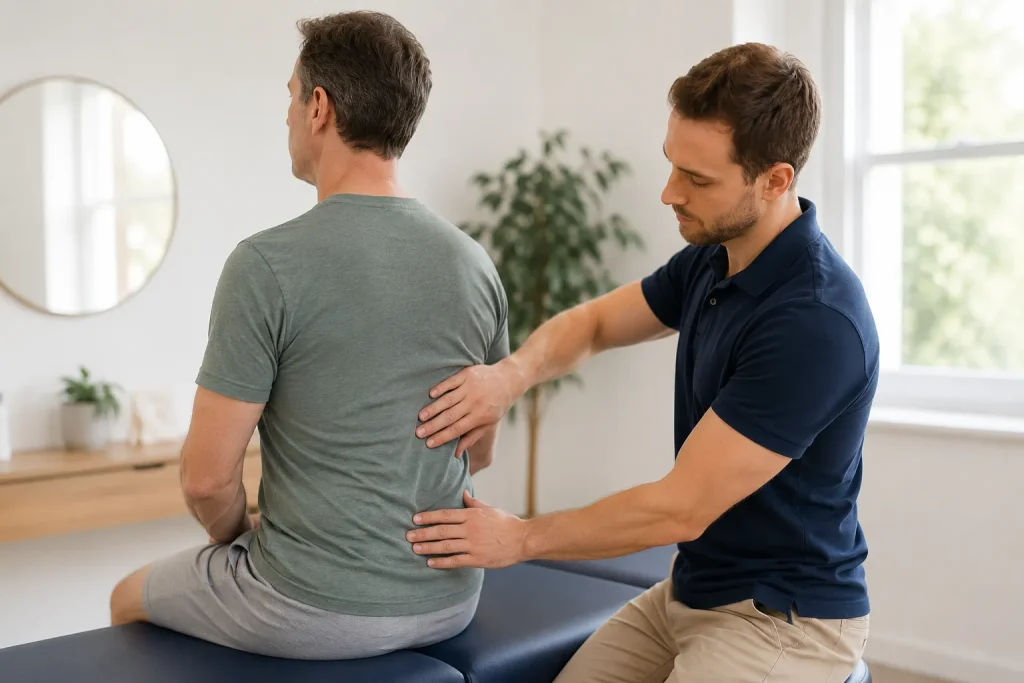
When to See a Professional Instead
Red light therapy is a general wellness routine — not a replacement for medical care. See a healthcare professional rather than relying on a home device alone if you experience:
- Discomfort that radiates down one or both legs with numbness or weakness
- Loss of bladder or bowel control
- Back discomfort following a significant injury or fall
- Symptoms that are worsening rather than settling
- Unexplained weight loss alongside back discomfort
- Fever combined with back discomfort
These can indicate something that needs direct medical evaluation, not a general wellness device.
The Alpha Red Light Therapy Belt and Mat for a Back Comfort Routine
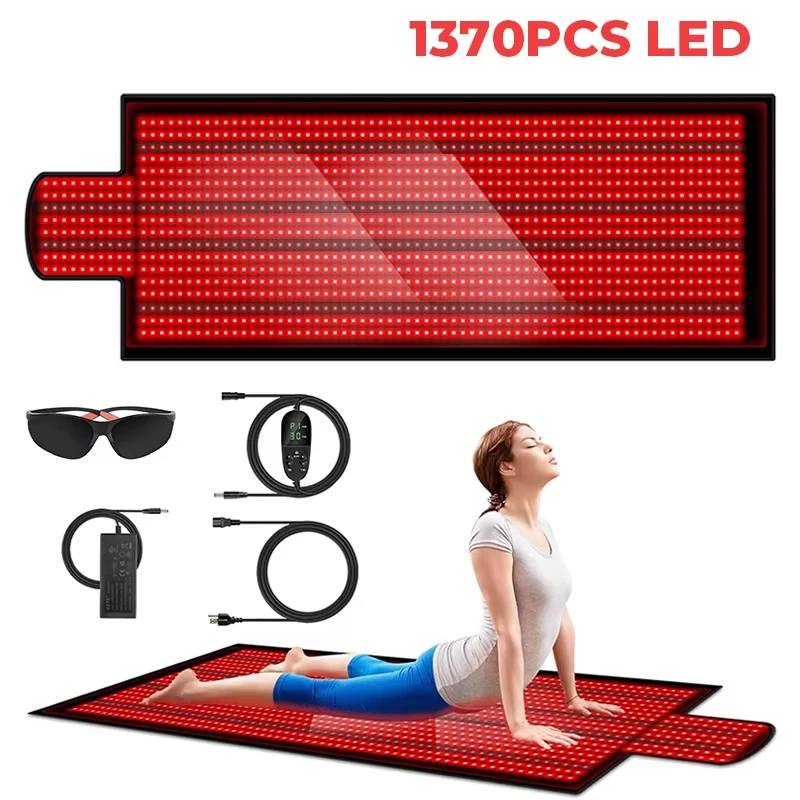
The Alpha Red Light Therapy range gives you two options for a back comfort routine, depending on how you prefer to use it.
Alpha Red Light Therapy Belt — Wraps directly around your lower back for hands-free, focused coverage. Ideal if you want to use it while sitting, reading, or relaxing in the evening. Read the full belt review →
Alpha Red Light Therapy Mat — Covers your entire posterior chain at once, suited to a broader routine across the mid and upper back as well as the lower spine. See our full body guide →
Both use the 660nm + 850nm wavelength pairing, are designed for direct skin contact, and are built for consistent at-home use. They're general wellness devices, not a treatment for any diagnosed condition — if you have one, your own health professional's plan comes first, and a device like this can be a reasonable addition to it, not a replacement for it.
Frequently Asked Questions
How long does it take to notice a difference? There's no reliable fixed timeline — it varies by person and by cause. A realistic approach is a few weeks of consistent, short sessions rather than expecting a fast result.
Is red light therapy better than a heating pad? They're different tools. A heating pad relies on surface heat to relax muscles temporarily. Red light therapy uses specific wavelengths and is generally used as part of a broader, ongoing routine rather than a one-off fix — neither is objectively "better," they suit slightly different situations.
Can I use red light therapy if I have a herniated disc? A herniated disc is a specific, diagnosed structural condition — this is exactly the situation where you should be working with a physical therapist or doctor first. A general wellness device isn't a substitute for that guidance, though it may be something your own professional is comfortable with alongside their plan.
Should I use it before or after exercise? Either can fit into a routine. Some people prefer it before mobility work, to loosen up first; others prefer it afterward, as part of winding down. Choose whichever you'll actually stick with.
Is it safe to use every day? Daily use as directed is generally considered low-risk for a general wellness device. If you're new to it, start with shorter sessions and see how you respond before committing to daily use.
Will it work for everyone's back discomfort? No single routine works the same for everyone. It tends to be most worth trying as part of a broader approach that includes movement, and — where a specific condition is involved — guidance from a health professional.
The Bottom Line
Red light therapy is a reasonable, low-risk addition to a back comfort routine for many people — particularly paired with movement and used consistently over several weeks. It isn't a fix for every type of back discomfort, and it works best as part of a broader routine, not a standalone answer.
For most people dealing with everyday stiffness or post-activity soreness, a quality device used consistently — alongside gentle movement — is a low-risk, reasonable option worth trying.
Ready to start? Explore the Alpha Red Light Therapy belt and mat and build a back comfort routine around them.
→ Shop the Alpha Red Light Therapy Range
This article is for general information only and does not constitute medical advice. The products discussed are general wellness devices and are not intended to diagnose, treat, cure or prevent any disease or medical condition. Results vary between individuals. If you experience persistent, worsening, or severe back discomfort, or any of the warning signs listed above, consult a qualified healthcare professional.